
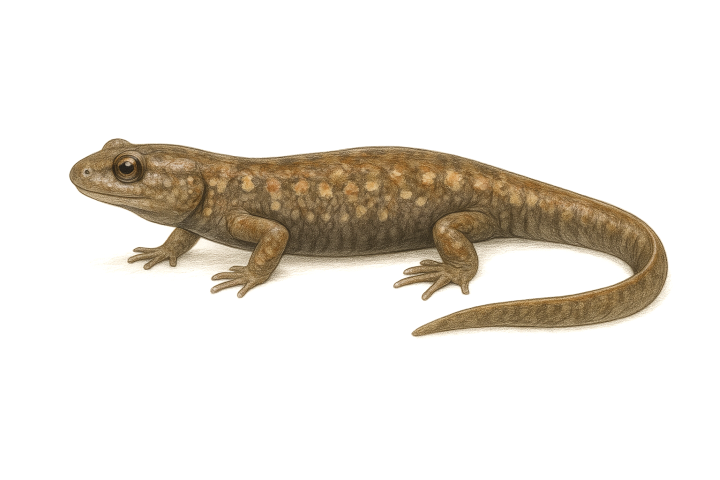
If you’re exploring a cool, shady stream in the southern Appalachian Mountains, you might just spot one of the rivers’ stealthiest residents — the Black-bellied Salamander. This stout, rugged amphibian lives where the water rushes and trickles, clinging under rocks and darting away like a shadow. It stands out from the crowd with its dark, belly-colored name and impressive ability to stay put in fast-moving streams.
Size & Physical Appearance
Black-bellied Salamanders are on the larger side for stream salamanders, especially in the southern U.S. Adults typically range from 4 to 6.5 inches long, though some can reach up to 7 inches.
They have a robust, muscular body and a fairly big head compared to other salamanders. Their upper surface is usually dark brown to black or gray, sometimes with a hint of mottling or four faint light spots on each side — which is where the species gets its name (quadramaculatus means “four spots”). The underbelly is where things get really distinctive — it’s almost entirely black, setting it apart from many other streamside species.
Juveniles tend to be lighter with a clearer pattern of spots or speckling along their sides, which fades as they mature.
Habitat and Range
Black-bellied Salamanders are stream specialists. They live in cool, clear, mountain streams with rocky bottoms and lots of cover — think mossy rocks, leaf litter, and submerged logs. They’re highly aquatic compared to many other woodland salamanders and usually stick close to water their entire lives.
You’ll find them mostly across the Southern Appalachian Mountains, especially in:
- North Carolina
- South Carolina
- Georgia
- Tennessee
- Virginia
They prefer elevations from 1,000 to over 5,000 feet, often found in protected hollows and stream ravines.
Diet
These salamanders aren’t picky eaters. They’re ambush predators, usually hunting at night. Their diet is made up of insects, worms, small aquatic invertebrates, and even other salamanders (yes, they can be a bit cannibalistic if given the chance).
In fact, in some streams, they’re the top amphibian predator — they’ve even been known to prey on smaller salamanders like duskies and two-lined species.
Lifespan
In the wild, Black-bellied Salamanders can live 10 to 15 years or possibly longer. We don’t have as much data from captivity since they’re not often kept as pets, but their long lifespan and slow maturity suggest they’d do similarly well under ideal conditions.
Identification Tips
Here’s how to tell a Black-bellied Salamander from species it might be confused with:
- Dusky Salamanders (Desmognathus spp.): Often live in the same stream habitats, but are usually smaller and have lighter bellies — not that stark black underside.
- Seal Salamander (Desmognathus monticola): These also live in mountain streams and can look similar, but adult Seals have a lighter, often marbled or speckled belly and lack the muscular “blocky” look of a mature black-bellied.
- Southern Two-lined Salamander: These have distinctive yellow bodies with black lines. No confusion there — black-bellied salamanders look much more solid and dark.
A confident ID comes down to that large size, blocky build, and most importantly, the solid black belly on adults.
Fun Fact
Black-bellied Salamanders are territorial tough guys. Males especially can get feisty, defending their space under a rock from other salamanders. They’ve been observed wrestling and even biting during disputes over choice habitat! Not something you’d expect from a creature that fits in the palm of your hand.
In Summary
If you’re ever lucky enough to poke around a cold mountain stream and see a bold-eyed salamander staring out from under a rock, there’s a good chance it’s a Black-bellied. Hardy, striking, and deeply tied to Appalachian waters, this is a species that reminds us how much life stirs quietly beneath the surface. Just remember to observe and never disturb — stream salamanders are sensitive to handling and habitat disruption.
Whether you’re a curious student, a family on a nature walk, or a herp enthusiast with a flashlight and water shoes, keep your eyes out for one of the most charismatic stream salamanders in the Southeast.