
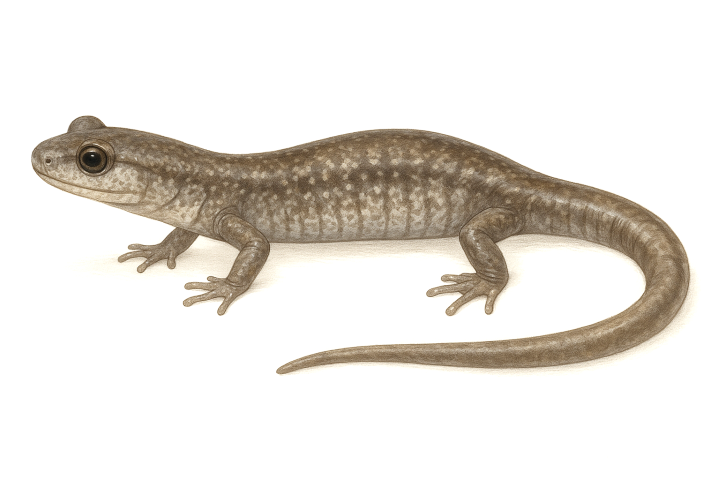
If you’re hiking through the misty forests of western North Carolina and happen to turn over a damp log, you might just spot the elusive Blue Ridge Gray-cheeked Salamander. This slender, secretive species is found in a surprisingly small area, making it one of the more intriguing salamanders in the U.S. What makes it stand out? Its limited range, subtle beauty, and quiet way of life.
Size & Physical Appearance
Blue Ridge Gray-cheeked Salamanders are relatively small. Adults typically grow between 3 to 5 inches in total length. Their coloring can vary, but most individuals have a dark gray to black body with a soft, silvery sheen on the cheeks — hence the name.
Younger salamanders tend to be slightly more slender, and while males and females look quite similar, males may have slightly longer limbs and a more noticeable mental gland (a small gland under the chin used during courtship). That said, it usually takes a close-up and some experience to tell them apart reliably.
Habitat and Range
This species is a true specialist. The Blue Ridge Gray-cheeked Salamander is known only from a few mountaintops in the southern Blue Ridge Mountains of western North Carolina. It lives in moist, heavily forested areas, often at elevations above 3,000 feet. These salamanders love the cool, damp microhabitats provided by decaying logs, leaf litter, and rocky crevices.
Because of their limited range and specific habitat needs, they can only thrive in intact, undisturbed forests. That makes conservation especially important for this species.
Diet
Like most lungless salamanders, the Blue Ridge Gray-cheeked Salamander is a nocturnal insectivore. At night, it comes out to forage for small invertebrates such as:
- Ants
- Mites
- Springtails
- Small beetles
They hunt by waiting patiently and then using their quick, sticky tongue to snatch prey — kind of like tiny, terrestrial chameleons.
Lifespan
In the wild, these salamanders can live for 10 years or more, although exact data is limited due to their cryptic nature. In captivity (in scientific study settings), they may live even longer, but they are not typically kept as pets due to their protected status and narrow habitat requirements.
Identification Tips
Telling the Blue Ridge Gray-cheeked Salamander apart from other salamanders can be tricky, especially in a region with so many Plethodon species.
Here’s what helps:
- Look for a solid dark body (usually black or dark gray) with a slightly silvery or bluish cheek area.
- Unlike some close relatives (like the Red-cheeked Salamander, Plethodon jordani), this species lacks colorful red markings.
- It’s a bit larger than some other Plethodon species in the area, with slightly broader heads and longer limbs.
Still stumped? Habitat helps too — if you’re in high-elevation forest in the specific Blue Ridge area around the southern Pisgah region, you’re probably in this species’ territory.
Fun Fact
The Blue Ridge Gray-cheeked Salamander is part of a group of salamanders that completely bypasses the tadpole stage. Instead of laying eggs in water, they lay them on land, and the young hatch out as tiny versions of the adults — no swimming phase required. It’s an amazing adaptation to life in the damp forest floor.
Wrapping Up
The Blue Ridge Gray-cheeked Salamander may be one of the quieter residents of Appalachia, but it tells an important story about biodiversity and the need to preserve fragile mountain ecosystems. So, next time you’re hiking high in the North Carolina mountains, keep an eye on the forest floor — there’s a whole world of tiny wonders right under your feet.