
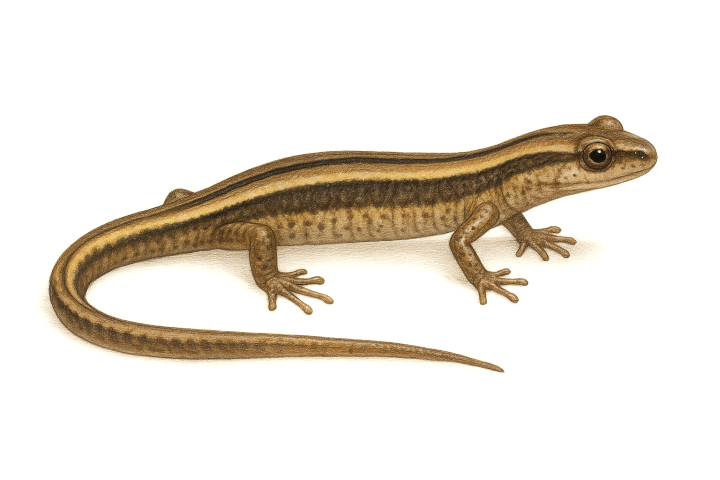
Meet the Blue Ridge Two-lined Salamander — a small, slender amphibian that lives in the cool, shaded mountain streams of the southeastern United States. This little salamander might be easy to overlook, but it plays a big role in stream ecosystems. With its golden-yellow body and bold side stripes, it stands out once you know what to look for. It’s also a great species for beginners learning to spot salamanders in the wild.
Size & Physical Appearance
Blue Ridge Two-lined Salamanders are on the small side. Adults usually measure between 2.5 to 4.5 inches in total length.
Their bodies are a yellow to orangish-yellow color, with two dark lines running from the eyes down either side of the back — hence the “two-lined” name. Between the lines, you’ll often see a sprinkling of dark flecks or spots.
Juveniles look similar to adults, but they tend to be duller in color. Males and females are hard to tell apart unless you’re really up close during the breeding season. During that time, males develop swollen cloacal glands and slightly darker coloration on their sides and tails.
Habitat and Range
This salamander is native to the southern Appalachian Mountains, especially in the Blue Ridge region. You’ll find it in parts of:
- North Carolina
- South Carolina
- Georgia
- Tennessee
- Virginia
- and a bit of eastern Kentucky
They prefer clean, cold, fast-moving streams in forested areas, often with rocky substrates. You’ll usually spot them hiding under rocks, logs, or leaf litter along stream edges. They’re most commonly found at mid to high elevations — typically between 1,500 to 4,500 feet.
Diet
Blue Ridge Two-lined Salamanders are insectivores. In the wild, they feed on:
- small aquatic insects
- midges and mayflies
- springtails
- tiny crustaceans
They use their sticky tongues to snap up prey quickly. Larvae, which live in water, tend to eat aquatic invertebrates like midge larvae and even smaller tadpoles when available.
Lifespan
In the wild, their average lifespan is around 5 to 7 years, though this can vary depending on conditions. There’s not a lot of data about their lifespan in captivity, but like many small salamanders, they’re probably tricky to keep due to their specific habitat needs.
Identification Tips
The Blue Ridge Two-lined Salamander can be a little confusing to ID because it looks similar to other two-lined species. Here’s how to tell them apart:
- Compare with the Southern Two-lined Salamander (Eurycea cirrigera): The Blue Ridge species tends to have a more richly colored yellow to orange back, and the dark stripes are often wider and better defined. E. cirrigera usually has a paler yellow tone and a more widespread range in the Southeast.
- Habitat helps: E. wilderae is found mostly in high-elevation mountain streams, while E. cirrigera tends to be in lower elevations and more widespread areas.
- Check the spotting: Blue Ridge Two-lined Salamanders often have more distinct spotting between the side lines than some of their relatives.
If you’re unsure, location and elevation are often your best clues.
Fun Fact
Here’s something neat: their larvae can stay in the water for up to three years before transforming into adults. That’s unusually long for a salamander this size! This extended larval period lets them take full advantage of cold, stable mountain stream environments.
In Summary
The Blue Ridge Two-lined Salamander is a small but striking amphibian known for its bold stripes, golden coloration, and love of mountain streams. It’s a great example of how specialized and localized some amphibian species can be. If you’re hiking near a mountain stream in the Blue Ridge region and look carefully under logs or stones near the water, you just might meet one of these slippery little treasures.
Just remember — always replace the logs or rocks gently and never remove salamanders from the wild. They’re an important part of the ecosystem and deserve to stay right where they belong.