
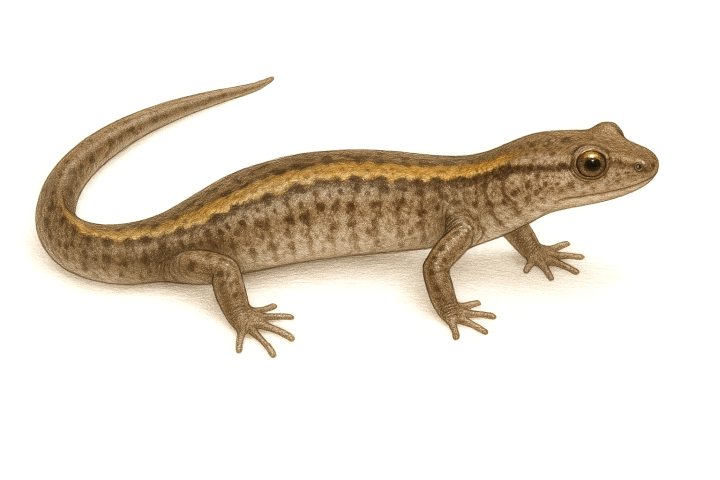
The Carolina Mountain Dusky Salamander might be small and shy, but it’s a fascinating little amphibian if you know where to look. Found mostly in the misty mountain forests of the southeastern U.S., this species is a bit of a specialist — it thrives in cool, clean streams and seeps tucked into rocky hillsides. If you’re hiking through the southern Appalachians and spot a slender, dark salamander darting under a rock near the water, there’s a good chance you’ve just met one.
Size & Physical Appearance
Adult Carolina Mountain Dusky Salamanders are on the small side. Most range from 2.5 to 4.5 inches long (including the tail), but some can get a little bigger.
Their coloring can vary, but they’re usually dark brown or gray with a lighter stripe down the back. That stripe — usually tan, reddish, or yellowish-brown — is often bordered by darker pigment, which can make it stand out. You might also notice tiny white or yellowish flecks along the sides.
One cool thing: males tend to have a more swollen area around their snout and jaw during breeding season. Juveniles often have more clearly defined spotting or a more contrasting stripe than adults.
Habitat and Range
This species is a true Appalachian local. It’s mostly found in the southern Appalachian Mountains, especially in western North Carolina, eastern Tennessee, and parts of northern Georgia and South Carolina.
They love cool, moist, forested environments, especially along rocky streams, springs, and seepage areas. You’ll usually find them at higher elevations, often above 3,000 feet, though they can occur a bit lower too.
They’re quite sensitive to pollution and habitat disruption, so their presence is often a good sign that the local environment is healthy.
Diet
These salamanders are opportunistic feeders. Their diet mainly includes:
- Small insects
- Spiders
- Worms
- Tiny crustaceans
They hunt mostly at night, using their sticky tongues to snag prey from leaf litter or damp rock surfaces. In a way, they act like little forest cleanup crews, helping control insect populations.
Lifespan
In the wild, Carolina Mountain Dusky Salamanders generally live around 8 to 10 years, though some may live longer under ideal conditions.
In captivity (like in educational settings), they can potentially live longer, but keeping the right moisture and temperature levels is tricky, and this species really belongs in the wild.
Identification Tips
Carolina Mountain Dusky Salamanders can be tricky to tell apart from other dusky salamanders in the same area — especially from the Allegheny Mountain Dusky Salamander (Desmognathus ochrophaeus) and others in the Desmognathus genus.
Here are a few tips:
- Tail shape: Carolina Mountain Dusky Salamanders have a tail that’s slightly keeled — meaning it has a gentle ridge along the top edge. Watch for this compared to more rounded tails on other species.
- Back stripe: Their dorsal stripe is usually wavy or irregular and may have a darker border, but this varies. Some individuals may look almost solid brown.
- Location matters: If you’re in the southern Appalachians at a cooler, higher elevation, that narrows your options down a lot.
If you’re not sure, location, body size, pattern, and tail shape together can help make the call — but identification can be tough even for experts when these species overlap.
Fun Fact
Carolina Mountain Dusky Salamanders don’t have lungs! Like many in their family, they actually breathe through their skin and the lining of their mouth — which is one of the many reasons they need moist environments to survive. If their skin dries out, they can’t get enough oxygen.
This unique trait also makes them great “canaries in the coal mine” for monitoring forest and stream health. If they disappear, it’s a red flag that something in the ecosystem might be going wrong.
Final Thoughts
The Carolina Mountain Dusky Salamander may not be as flashy as a treefrog or as big as a bullfrog, but it plays an important role in its mountain ecosystem. It’s a great reminder that even the smallest creatures matter, especially when it comes to biodiversity and the health of our streams and forests.
Next time you’re exploring a cool mountain trail or flipping rocks near a creek in the southeast, keep an eye out. Just remember — look, enjoy, and then gently return anything you find right back where it came from. These little guys depend on people respecting their wild homes.