
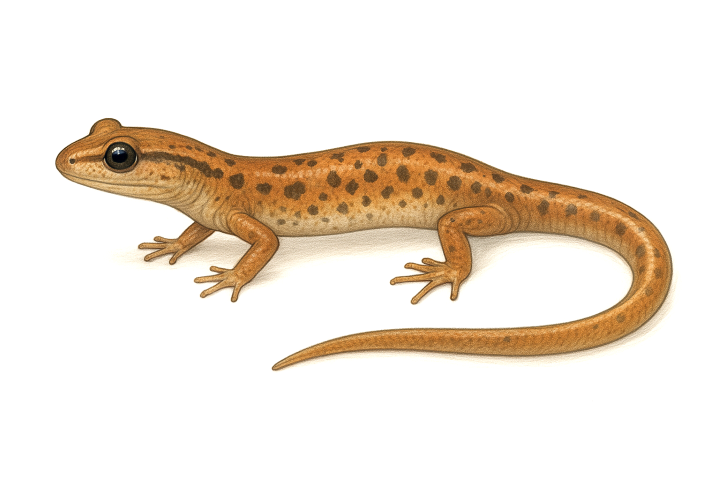
The Cave Salamander is a striking little amphibian known for its bold coloring and unusual choice of home. As its name suggests, this salamander spends most of its life tucked away in the cool, damp world of caves and rocky crevices. Its bright orange or reddish body dotted with black spots makes it one of the most eye-catching salamanders in North America. Despite its flashy appearance, it’s a quiet, reclusive species that can be hard to spot unless you know just where to look.
Size & Physical Appearance
Cave Salamanders are medium-sized, typically ranging from 4 to 6.5 inches in total length, including the tail (which can make up over half their body length). Their vibrant orange to reddish body is covered in irregular black spots that vary in size and concentration from one individual to the next.
They have a narrow head, long limbs, and an especially long tail that helps them maneuver in rocky environments. Their big black eyes are adapted for the low-light conditions inside caves and crevices. There’s not a huge difference between males and females in coloration, but during the breeding season, males may have slightly swollen cloacal areas and more pronounced mental glands (used in courtship).
Habitat and Range
True to their name, Cave Salamanders love dark, damp environments. You’ll most often find them in:
- Limestone caves
- Under rocks in wooded ravines
- Near damp cliff faces
- In the twilight zones of caves (not the deepest parts)
They prefer high-humidity areas with access to clean water. Cave Salamanders are most active during the cooler, wetter times of year — spring and fall especially.
In terms of range, they are found primarily in the eastern and central U.S. Look for them in:
- Southern Indiana and Illinois
- Kentucky and Tennessee
- Missouri and northern Arkansas
- Northern Georgia and Alabama
They’re strongly tied to areas with karst topography — meaning lots of caves, springs, and sinkholes.
Diet
Cave Salamanders are predators, but thankfully only if you’re an insect. They primarily eat:
- Small insects
- Spiders
- Crickets
- Springtails and other cave invertebrates
They’re opportunistic feeders, snapping up whatever small prey comes their way. In cave environments, food can be scarce, so they’re not especially picky. Their tongue is sticky and quick — perfect for nabbing fast-moving insects.
Lifespan
In the wild, Cave Salamanders can live up to 10 years. In captivity, with consistent care and no predators, they may live a bit longer. They take a couple of years to reach maturity, and like many salamanders, they can regenerate tail tips and recover from minor injuries remarkably well.
Identification Tips
Cave Salamanders are sometimes confused with other orange or red salamanders, especially:
- Red Salamanders (Pseudotriton ruber) — These are similar in color but are usually stockier with shorter tails and tend to have more uniformly spaced spots. Red Salamanders also have a reddish eye, while Cave Salamanders have a dark, almost black eye.
- Long-tailed Salamanders (Eurycea longicauda) — These are closely related and share many of the same habitats. They’re yellow to orange with black streaks or bars instead of dots. Their tails are even longer and more whip-like than the Cave Salamander’s.
Focus on the bright orange color, scattered black spots, long limbs, and dark eyes to make an accurate ID.
Fun Fact
Cave Salamanders can find their way back to their home cave if removed — and some studies suggest they may navigate by using their sense of smell. It’s a skill that’s still being studied but hints at how tuned in they are to their habitat. They might not have GPS, but they do have a built-in compass of sorts.
Got a local cave or rocky forest nearby? During spring or after a rain, keep your eyes peeled near cave entrances and under moist logs or rocks. Just be careful not to disturb them — and always return cover objects gently if you go looking. These little guys are part of a fragile ecosystem that depends on clean water and undisturbed habitat.
If you’re lucky enough to spot a Cave Salamander, take a moment to admire this hidden jewel of the underground world.