
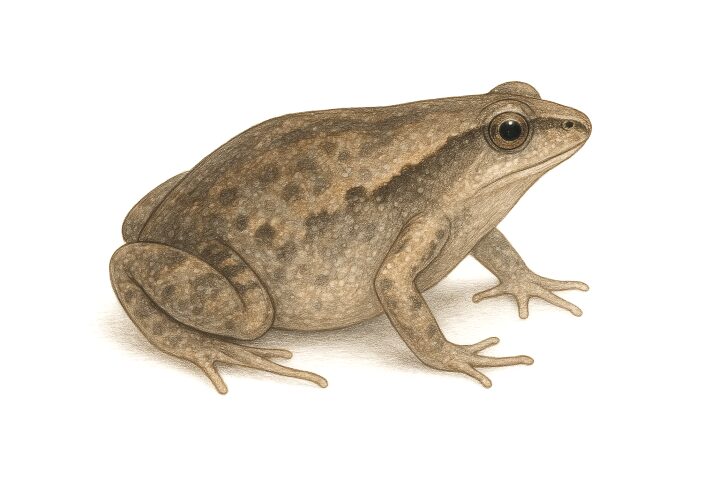
At first glance, the Eastern Narrow-mouthed Toad might not even look like a toad. It’s small, secretive, and has a body more like a jelly bean with legs than your typical bumpy backyard hopper. But this quirky little amphibian is full of surprises — from its ant-based diet to its unique call that sounds a bit like a bleating lamb. If you’re lucky enough to spot one, you’re in for a treat.
Size & Physical Appearance
The Eastern Narrow-mouthed Toad is, well, narrow. Adults measure only about 0.75 to 1.5 inches long — barely bigger than a grape. Their body is flattened and teardrop-shaped, and their head comes to a point, which is where they get the “arrow-mouthed” name.
They’re usually gray, brown, or reddish with a mottled or solid appearance. Some individuals even have a faint light stripe running down the back, but colors can vary quite a bit depending on the soil and leaf litter in their habitat. Juveniles look similar to adults but are naturally smaller and may have slightly brighter coloring when they first metamorphose.
Don’t expect to see big warty skin like with true toads — their skin is smooth and almost rubbery-looking. Both males and females look similar, although during breeding season, males have a darker throat due to their enlarged vocal sac.
Habitat and Range
These little guys prefer to stay hidden in warm, moist environments with lots of cover. You’ll often find them under logs, rocks, piles of leaf litter, or in shallow burrows. They love places with loose soil and high humidity — think woodlands, coastal plains, pine forests, and even backyard gardens if conditions are damp enough.
They’re found throughout the Southeastern United States, from eastern Texas and Oklahoma, across the Gulf Coast, and up the Atlantic Coast into North Carolina and southern Virginia. They aren’t fans of high elevations — you’re more likely to find them below 1,000 feet.
Diet
The Eastern Narrow-mouthed Toad has a diet that’s pretty specialized — mostly ants. In fact, over 90 percent of what it eats are ants, especially those in the Formica and Solenopsis (fire ant) genera.
Its narrow mouth and pointed snout are perfect for slurping up tiny prey. It also eats termites, small beetles, and other tiny invertebrates, but ants are definitely the main course. These toads even secrete a sticky substance to help them snag their food quickly.
Lifespan
In the wild, Eastern Narrow-mouthed Toads can live around 5 to 7 years. In captivity, where predators and environmental stresses are minimized, they may live a bit longer — possibly up to 10 years — though long-term care in captivity can be tricky because of their specialized diet and secretive habits.
Identification Tips
It’s easy to confuse the Eastern Narrow-mouthed Toad with small frogs or even juvenile toads, but here are a few ways to tell them apart:
- Body shape: Look for the broad, flat body with a snout that comes to a point — they almost look like a drop of water.
- Skin texture: They’re smooth, not warty like most toads.
- No visible tympanum (ear): Unlike many frogs and toads, this species does not have a visible external eardrum.
- Call: During the breeding season, listen for a nasal, bleating “waaaaaaah” sound — it’s very different from the chirps or trills of other frogs.
Also important: when disturbed, they often tuck their head under their body and remain motionless — a cute but effective way to avoid predators.
Fun Fact
They have a built-in ant repellent! The Eastern Narrow-mouthed Toad produces a skin secretion that helps protect it from the bites and stings of the ants it eats. This secretion can irritate human eyes and mucous membranes too, so if you ever handle one (gently, of course), be sure to wash your hands afterward.
This clever adaptation lets them chow down on prey that most other frogs avoid entirely. Nature is pretty awesome.
Want to hear one? Search for recordings of the Eastern Narrow-mouthed Toad’s call online — it might just sound like something from a sci-fi movie. If you live in the Southeast, keep your ears open after a warm summer rain, and you might hear one for yourself!