
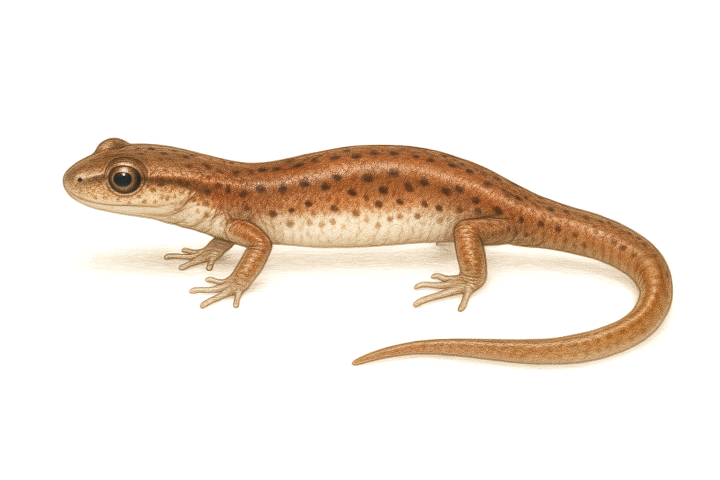
The Four-toed Salamander may be tiny, but it’s one of North America’s more unusual amphibians. With its bright white belly covered in bold black speckles and those distinctive four toes on its hind feet (most salamanders have five), this species stands out — if you can manage to find it. Four-toed Salamanders are quiet, elusive creatures that often hide under moss or leaf litter. But once you learn where to look and what to look for, discovering one becomes a memorable experience.
Size & Physical Appearance
These salamanders are on the smaller side, typically measuring between 2 to 4 inches long. Their backs are usually a reddish-brown or grayish brown, sometimes with a bit of coppery sheen. One of the most striking features is the sharp contrast between the back and the white belly marked with black dots — it almost looks like a tiny creature wearing a tuxedo underneath.
Males and females look pretty similar, though females tend to be slightly larger. Juveniles usually resemble the adults but are smaller and sometimes appear a bit duller in coloration.
And yes, let’s talk about the toes — only four toes on the hind feet. That alone sets them apart from many other salamanders you might find in the same habitat.
Habitat and Range
Four-toed Salamanders are found in a wide range of the eastern United States, from Minnesota and Maine down to parts of Alabama and the Carolinas. They tend to prefer moist forests with abundant sphagnum moss, especially near wetlands like bogs, swamps, and seeps.
They favor places with moss mats, decaying logs, and shaded moist soil. During the breeding season, they often select sites with standing shallow water and thick moss — which they actually rely on for nesting.
Elevation varies depending on where they are in the range, but they are found from lowlands to mid-elevation forests.
Diet
Like many small salamanders, the Four-toed Salamander feeds on tiny invertebrates. Their diet includes:
- Springtails
- Small beetles
- Spiders
- Mites
- Worms and insect larvae
They hunt mostly at night, using their sticky tongues to snag prey as they crawl through moss and leaf litter.
Lifespan
In the wild, Four-toed Salamanders typically live around 4 to 5 years, although some may live longer. In captivity, when given proper care, they may reach up to 8 years.
Identification Tips
This is where things get fun — and a bit tricky. Four-toed Salamanders can look like several other small woodland species, but a few details can help:
- Four toes on hind feet — most salamanders have five, so this is the easiest way to tell.
- White belly with sharp black spots — very distinctive compared to the solid-colored bellies of most other salamanders.
- Constriction at the base of the tail — this “break point” allows them to lose their tail if grabbed by a predator.
- No nasolabial grooves — unlike the very similar Red-backed Salamander, which has those grooves.
If you’re comparing them to a Red-backed or Lead-backed Salamander, look closely at those toes and the belly. Four-toed Salamanders are also more likely to be found in mossy wetlands rather than dry upland forest.
Fun Fact
Four-toed Salamanders are one of the few amphibians in North America known to guard their eggs. Females often create communal nests — sometimes multiple females will lay eggs together under moss or other cover, and then one or more of them might stick around to watch over the clutch. That kind of maternal care is pretty rare among amphibians!
And if disturbed, they can drop their tail as a distraction — kind of like a lizard. The tail wiggles and draws attention while the salamander makes a getaway.
In Summary
Whether you’re exploring a quiet bog in New England or poking around a wet mossy patch in the southern Appalachians, keep an eye out for this often-overlooked amphibian. The Four-toed Salamander may be small, but its unique features and fascinating behavior make it one of the more charming residents of North America’s amphibian world. Just remember to tread lightly — their habitats are sensitive, and observing without disturbing is always best.