
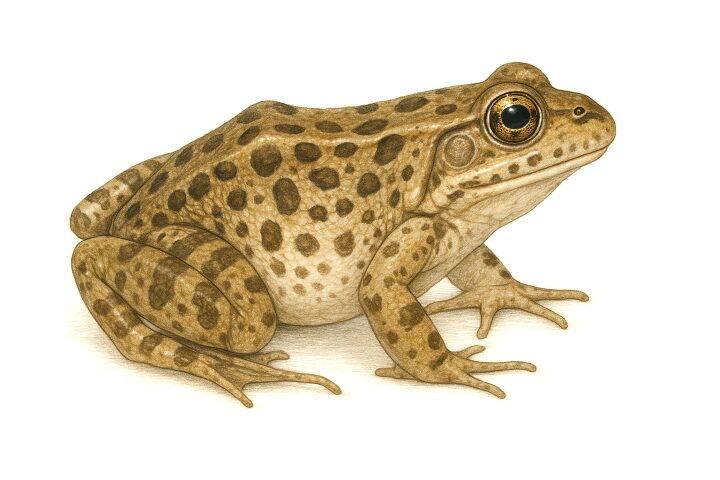
The Gopher Frog is one of those hidden gems of the southeastern U.S. — a stout, secretive amphibian that spends much of its life underground. What makes this frog especially fascinating is its unusual partnership with other animals: it often takes shelter in burrows dug by Gopher Tortoises. This makes it just as much a creature of the sandhills and pine flatwoods as it is a wetland dweller. It’s not the easiest frog to find, but it’s definitely worth knowing about.
Size & Physical Appearance
Gopher Frogs are relatively large for frogs, with adults typically measuring between 2.5 and 4 inches long from snout to tailbone (snout to vent).
These frogs have a with a large head and rounded body. Their skin is warty and textured, often a shade of light gray, brown, or tan with bold, irregular dark spots scattered across the back. Think of a pancake with chocolate chips — a pretty close visual.
A key ID feature is the light-colored fold of skin running down each side of the back (these are called dorsolateral folds). Their bellies are usually pale with some dark mottling.
Males and females look pretty similar, but males may develop darkened, rougher thumbs during breeding season. Juveniles are smaller and more uniformly colored until their spots come in.
Habitat and Range
Gopher Frogs are highly dependent on two very different types of habitats: dry, sandy uplands for most of the year, and temporary wetlands for breeding in late winter or early spring.
They’re mainly found in the southeastern United States, including parts of Florida, Georgia, South Carolina, Alabama, Mississippi, and Louisiana (though populations are now very spotty). They love sandhills, scrub, longleaf pine forests, and pine flatwoods — especially places that have been maintained with natural fire cycles.
At higher elevations they’re rare, but they can be found from sea level up to about 500 feet.
Diet
Gopher Frogs are serious ambush predators. They mostly eat insects, spiders, beetles, and small invertebrates. Larger frogs have even been known to eat smaller frogs and little snakes on occasion.
They’ll hang near burrow entrances or leaf litter and lunge at prey that comes too close — a sit-and-wait strategy that fits well with their burrow-loving lifestyle.
Lifespan
In the wild, Gopher Frogs usually live around 4 to 6 years, although some individuals may live longer under ideal conditions. In captivity, when studied or kept in protected environments, they may live slightly longer if cared for properly.
Identification Tips
Gopher Frogs are sometimes confused with other spotted frogs, especially Southern Leopard Frogs. Here are a few ways to tell them apart:
- Gopher Frogs are chunkier, with a blunt snout and short legs, while Leopard Frogs are slimmer and more agile-looking.
- Their spots are more blotchy and irregular, not neat and circular like Leopard Frogs.
- Gopher Frogs have that distinct wavy dorsal fold on each side of the back, separating the top from the flanks.
- Unlike Leopard Frogs, which often hang out in ponds year-round, Gopher Frogs spend most of their lives burrowed underground.
If you’re looking in a sandy pine forest and see a frog hopping away from a burrow, odds are you’re looking at a Gopher Frog.
Fun Fact
Gopher Frogs rely on the burrows of Gopher Tortoises, Pocket Gophers, or even crayfish to survive the dry parts of the year. The shelter provides moisture, a stable temperature, and protection from predators. Without these borrowed burrows, they probably couldn’t survive — a great example of how different species depend on each other to thrive.
Wrap-Up
Gopher Frogs may not be the easiest frogs to find, but they’re a key part of the southeastern ecosystem — especially longleaf pine and sandhill forests. Their reliance on burrows and ephemeral wetlands makes them a unique amphibian, and sadly, one that’s vulnerable in many parts of its range due to habitat loss and fire suppression. If you live near suitable habitat, be sure to keep an eye (and ear) out during breeding season — their low, snore-like call might just lead you to one of nature’s more elusive frogs.