
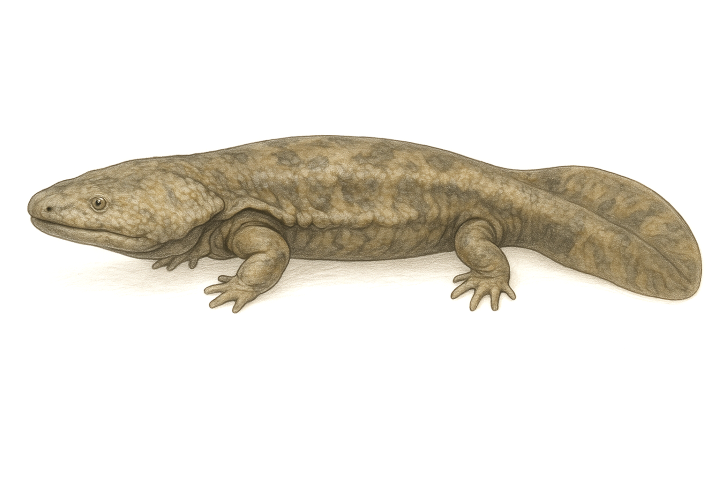
The Hellbender (Cryptobranchus alleganiensis) might have one of the wildest names in the amphibian world — and it looks just as unforgettable. This giant, fully aquatic salamander is also known as the “snot otter,” “lasagna lizard,” or “old lasagna sides,” thanks to its wrinkly, rippling skin. Big, strange, and rarely seen, Hellbenders are the largest amphibians in North America and one of the few living members of an ancient lineage that’s been around for millions of years.
Despite their odd appearance, Hellbenders are a crucial part of healthy freshwater ecosystems. If you’re lucky enough to spot one, you’re looking at a living fossil.
Size & Physical Appearance
Hellbenders are large — really large for a salamander. Most adults measure between 11 to 20 inches long, but some can grow up to 29 inches. That’s about the length of a small dog.
They have flattened bodies and broad, flat heads, with tiny eyes and short, stubby legs. Their skin is covered in loose, fleshy folds — especially along the sides — which help them absorb oxygen from the water. Color ranges from brown to grayish, often with darker blotches or mottled patterns.
Males and females are similar in appearance, but males tend to have a slightly larger cloacal swelling during breeding season. Juveniles look like miniature adults but with external gills, which they lose as they mature.
Habitat and Range
Hellbenders are homebodies. They stick to cold, clean, fast-flowing streams and rivers, usually with rocky bottoms. They’re most active at night and spend most of their lives hidden under large rocks or submerged logs.
You’ll find them in parts of the eastern and central United States, including Pennsylvania, New York, Ohio, West Virginia, Kentucky, Tennessee, North Carolina, Georgia, Missouri, Arkansas, and parts of Mississippi and Alabama. Their range is split into two subspecies:
- Eastern Hellbender (Cryptobranchus alleganiensis alleganiensis) – Found mostly in the Appalachian region.
- Ozark Hellbender (C. a. bishopi) – Restricted to a few rivers in southern Missouri and northern Arkansas.
They prefer elevations between 300 and 2,500 feet. Clean, highly oxygenated water is essential — pollution and siltation are big threats.
Diet
Hellbenders are opportunistic carnivores. Their favorite food is crayfish, but they’ll also eat small fish, insects, worms, tadpoles, and pretty much anything they can catch, swallow, and fit in their mouths.
They have strong jaws and swallow their prey whole. Fun fact: Hellbenders don’t have many teeth on the top of their mouths — just a single row on the lower jaw and roof of the mouth called vomerine teeth.
Lifespan
In the wild, Hellbenders can live for 25 to 30 years, and some individuals in captivity have lived over 30 years! Their long lifespan combined with low reproductive rates makes protecting adults especially important.
Identification Tips
It’s almost impossible to confuse a Hellbender with anything else — but here are some tips just in case:
- Size: Hellbenders are much larger than any other native salamander.
- Skin folds: Those rippling, wrinkly sides are a dead giveaway.
- Aquatic lifestyle: Unlike other salamanders which may migrate to water to breed, Hellbenders spend their entire lives underwater.
- No gills: Adult Hellbenders do not have external gills, unlike fully aquatic species like the axolotl.
If you spot a big, blobby salamander crawling under a rock in a clear mountain stream, chances are you’ve found yourself a Hellbender.
Fun Fact
Despite their scary-sounding name, Hellbenders aren’t aggressive and pose no danger to people. One theory about the name? Early settlers saw these weird, otherworldly creatures and figured they looked like something that belonged in “hell, bending along the river bed.” The nickname stuck — and made them a bit of a folk legend.
Did You Know?
Hellbenders breathe primarily through their skin, using those extra skin folds to absorb oxygen from fast-moving water. That’s why they’re so sensitive to water pollution and sedimentation — if their habitat isn’t just right, they can’t breathe properly.
Conservation Notes
Hellbender populations are declining in many parts of their range due to habitat loss, pollution, disease, and illegal collection. The Ozark subspecies is currently listed as Endangered by the U.S. Fish and Wildlife Service.
If you love amphibians and wild places, consider supporting efforts to conserve clean rivers and protect native habitat. Even simple actions like reducing runoff, picking up trash near streams, and supporting local conservation groups can help.
Wrapping Up
Hellbenders are some of the strangest and most fascinating amphibians in North America. They’re indicators of healthy water, living fossils from the era of the dinosaurs, and full of surprising quirks — from their skin folds to their slow-motion lifestyles.
If you ever find yourself walking along a cold, rocky stream in the Appalachian Mountains or Ozarks, keep an eye out. You might just be lucky enough to glimpse one of these secretive salamanders in the wild.
Just remember: look, don’t touch — Hellbenders are protected in many states, and they play a vital role in their freshwater homes.