
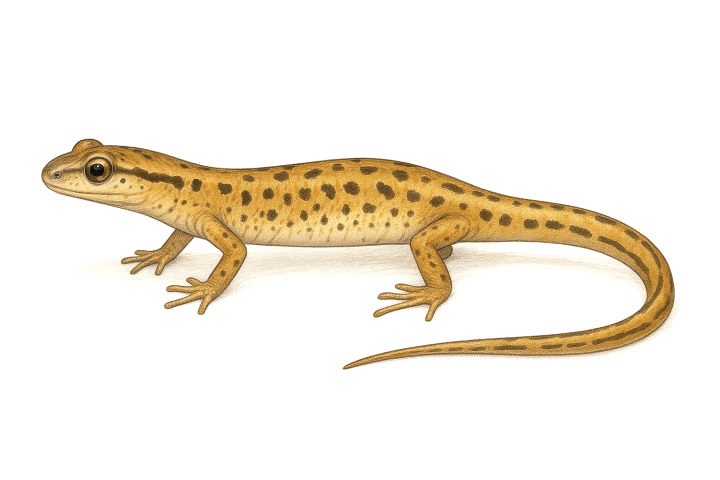
The Long-tailed Salamander might not be the most famous amphibian out there, but it definitely stands out — literally. Its tail can be more than half its total body length, giving it one of the longest tails of any salamander in North America. Add in its bright yellow-to-orange coloring and bold markings, and you’ve got one of the more eye-catching salamanders in the eastern United States. It’s shy, slim, and fast-moving, often darting into rock crevices when disturbed.
Size & Physical Appearance
Long-tailed Salamanders typically measure between 4 to 8 inches in total length — and about two-thirds of that length is tail. Their bodies are slender and flexible, helping them squeeze into tight spaces like cracks in rocks or spaces under logs.
Color varies, but they’re generally a yellow, orange, or reddish base color with plenty of dark brown or black spots and dashes along the back, sides, and tail. These markings often form broken lines, almost like small streaks or dashes. The tail itself is long and can sometimes look a bit flattened, especially at the base.
Males and females look quite similar, especially outside of breeding season. Juveniles tend to be paler with fewer markings, and their tails grow proportionally longer as they develop.
Habitat and Range
Long-tailed Salamanders are mostly found in the eastern and central United States, including parts of the Appalachian Mountains, the Ohio River Valley, and the interior highlands. States where you’re likely to spot them include Pennsylvania, West Virginia, Kentucky, Tennessee, Virginia, Ohio, Indiana, and parts of Illinois and Missouri.
They prefer moist, rocky environments. You’ll often find them:
- In and around limestone caves
- Beneath rocks and logs along stream banks
- In spring houses and other damp, shaded human structures
- At low to moderate elevations
They’re also a bit more tolerant of drier periods than some other salamander species, but they always retreat to damp hiding spots when things dry out.
Diet
Long-tailed Salamanders are insectivores. That means their diet mainly consists of:
- Small insects like ants, beetles, and flies
- Spiders and small arthropods
- Worms and small crustaceans (especially common around spring seeps)
They’re mostly nocturnal feeders, coming out at night to hunt tiny prey while staying hidden during the day. Their long, sticky tongue helps them snag food quickly.
Lifespan
In the wild, Long-tailed Salamanders can live for around 6 to 10 years, though exact lifespans aren’t always easy to document. In captivity, under the right conditions, they might live a little longer. These salamanders are secretive and fragile, so they’re not common pets — and most wild ones are best appreciated in their own habitat.
Identification Tips
It’s easy to confuse the Long-tailed Salamander with a few other narrowly built, spotted salamanders. Here’s how to tell them apart:
- Spotted Salamander (Ambystoma maculatum): This one has larger, more defined yellow spots and a chunkier body. It also doesn’t have the signature long tail.
- Two-lined Salamander (Eurycea bislineata): Similar body shape, but the two lines down its back are more defined, and its tail isn’t nearly as long relative to its body.
- Cave Salamander (Eurycea lucifuga): Also brightly colored and lives in similar environments, but the cave salamander has a shorter tail and more spotted, rather than streaked, markings.
Your best clue is the tail — if it looks especially long and whip-like relative to the body, you’re probably looking at a Long-tailed Salamander.
Fun Fact
The Long-tailed Salamander can actually drop part of its tail if a predator grabs it — a defense mechanism known as autotomy. The detached tail can twitch for several minutes, distracting predators and buying the salamander time to escape. The tail eventually regrows, but it’s often shorter or shaped a bit differently than the original.
Wrap-Up
If you’re out hiking near streams or caves in the eastern U.S., keep an eye out for this slender, quick-moving salamander with its extra-long tail. It’s a shy but fascinating part of the forest ecosystem, quietly helping control insect populations and serving as a sign of healthy, clean water habitats.
Remember — always look, but don’t touch. Amphibians have delicate skin that can be easily harmed by oils or chemicals from human hands. Taking a photo and leaving them undisturbed is the best way to enjoy these incredible animals.