
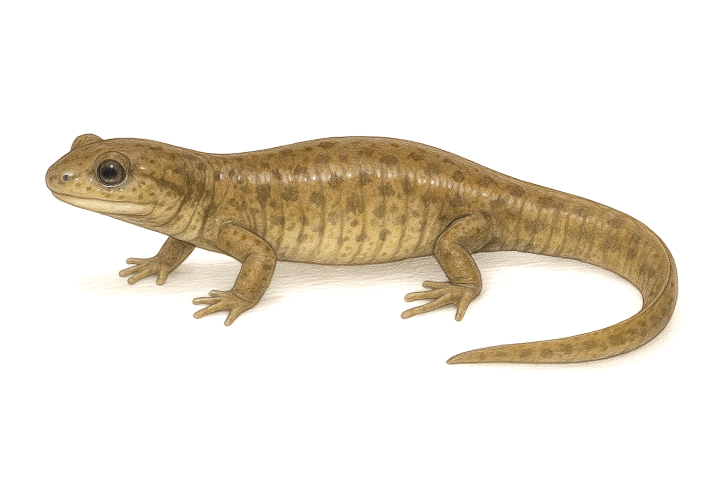
If you’re exploring the southeastern United States, keep an eye out for Mabee’s Salamander. This little amphibian loves tucked-away wetlands and pine forests and is a bit of a hidden gem. While it’s not as flashy as some other salamanders, what makes Mabee’s Salamander stand out is its secretive lifestyle and tightly connected relationship with vernal pools — those temporary spring ponds that fill up for just a few months each year. It’s one of those species that’s easy to overlook, but absolutely fascinating once you get to know it.
Size & Physical Appearance
Mabee’s Salamanders are considered small to medium-sized members of the mole salamander family. Adults usually measure between 3 to 4.5 inches long from snout to tail tip. Their color is generally dark gray, brown, or black, with small, scattered light gray or bluish flecks along the sides and back. These flecks can be subtle, so they don’t always catch the eye at first glance.
They’re often confused with other Ambystoma species, but Mabee’s Salamanders tend to have a more slender build and shorter tail than many of their relatives. Juveniles may have a lighter belly and can look more contrasty than adults, while males are typically slimmer and have longer tails than females — but overall, the differences between sexes are subtle.
Habitat and Range
This species sticks to the coastal plain of the southeastern United States, mainly from southeastern Virginia, through the Carolinas, and into parts of Georgia and northern Florida. It’s a lowland species, found mostly at elevations below 1,000 feet.
Mabee’s Salamanders are closely tied to temporary wetlands like seasonal ponds, depressional wetlands, and vernal pools, especially those surrounded by pine forests, flatwoods, or mixed hardwood lowlands. Adults spend most of the year hidden underground in burrows or under debris. They come out on rainy winter or early spring nights to migrate to their breeding ponds — usually the same one every year if it’s available.
Diet
These salamanders are carnivores. In the wild, Mabee’s Salamanders eat insects, spiders, worms, and small invertebrates they find in moist soil or leaf litter. They’re opportunistic feeders, meaning they’ll go after whatever small, moving prey is available and manageable.
Larval salamanders — the ones that live in water just after hatching — focus on a diet of zooplankton, tiny aquatic insects, and even other amphibian larvae if they’re big and hungry enough.
Lifespan
In the wild, Mabee’s Salamanders are thought to live around 5 to 10 years, although exact data is limited simply because they’re so secretive. In captivity (which is rare), similar Ambystoma species can live even longer with stable conditions.
Identification Tips
Telling Mabee’s Salamander apart from similar species can be tricky. Here are a few clues to help you:
- Smaller and more slender than species like the Spotted Salamander or the Marbled Salamander
- Lacks the bright yellow spots of the Spotted Salamander and the distinctive light bands of the Marbled Salamander
- Color tends to be with only faint, scattered flecks — not strong patterning
- Found in and temporary wetlands, especially east of the Piedmont
If you’re in the Southeast and see a mole salamander that looks unmarked or has faint speckling — and you’re near a quiet seasonal pool — there’s a decent chance it’s Mabee’s.
Fun Fact
Mabee’s Salamanders are so linked to vernal pools that whole populations can disappear if the ponds dry up too early or are filled in by development. They’re fascinating reminders of how entire amphibian lifecycles can hinge on just a few weeks of wet ground. Some adults migrate hundreds of yards through forests just to return to the same breeding pond they came from — something scientists call “site fidelity.”
Because of this close relationship with a specific kind of wetland, conservation of even small, seasonal water bodies is incredibly important for keeping this species around.
Keep Exploring
Mabee’s Salamander might not win any amphibian beauty contests, but its quiet life cycle and ties to vanishing wetlands make it a special and important species to watch. Whether you’re a student doing a project or just someone who loves learning about your local wildlife, understanding salamanders like this one helps connect the dots between ecosystems, conservation, and the fascinating creatures that live right under our feet.