
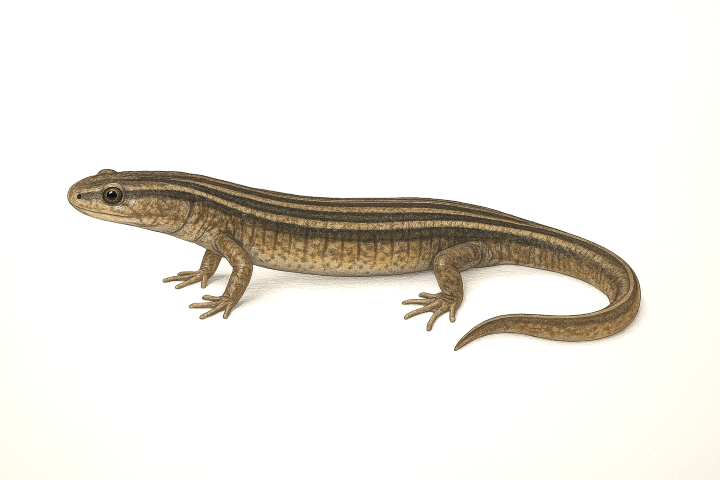
The Many-lined Salamander (Stereochilus marginatus) isn’t the flashiest amphibian in the forest, but it’s definitely one of the most interesting—especially if you’re into secretive, stream-loving critters. This slender little salamander spends most of its time under leaf litter or tucked into swampy pools in the southeastern U.S. It’s got fine, crisp lines running down its back, giving it a pinstriped look that makes it surprisingly stylish for a swamp dweller.
Size & Physical Appearance
Adult Many-lined Salamanders usually measure between 2.5 to 4.5 inches long (including the tail), though the tail alone can make up more than half that length.
They have a slender body with a relatively small head and long tail. Their base color tends to be yellowish-brown or grayish with numerous thin, dark lines running the length of the body from head to tail—hence the name!
Juveniles often look similar to adults but may be slightly more translucent or lighter in color. Males and females are not dramatically different in appearance, although males may have slightly more prominent jaws or cloacal swellings during the breeding season.
Habitat and Range
This species is native to the southeastern United States, mostly found in the Atlantic Coastal Plain. You’ll spot them (well, if you’re lucky) in parts of:
- North Carolina
- South Carolina
- Georgia
- Florida
- Alabama
- Mississippi
- Louisiana
They prefer slow-moving or still freshwater habitats—think swamps, bogs, floodplain forests, and vernal pools. These salamanders love hanging out under wet leaves, logs, and other debris that’s close to shallow water. They’re rarely found far from moisture, and almost always at low elevations.
Diet
The Many-lined Salamander isn’t picky, but it’s also no apex predator. They feed mostly at night on a variety of small invertebrates, including:
- insects
- spiders
- crustaceans
- earthworms
They’ll snap up almost anything they can fit in their tiny mouths, and their hunting style is pretty stealthy—they wait for prey to come near, then strike quickly.
Lifespan
In the wild, these salamanders are believed to live for roughly 5 to 7 years. There’s not a ton of data from captive populations since they’re not commonly kept, but similar species can live longer with optimal care.
Identification Tips
Confusing this salamander with others is pretty easy if you’re not paying attention. Here’s how to tell it apart:
- Lines, not spots: Unlike the spotted salamander or marbled salamander, the Many-lined has very fine, dark lines running lengthwise down the body, not blotches or spots.
- Slender build: They’re much thinner than mole salamanders, and more eel-like in appearance.
- Tail shape: Their tail is laterally compressed (kinda flattened side to side), which helps them slip through water and mud.
One species they’re sometimes mixed up with is the Southern Two-lined Salamander (Eurycea cirrigera). That species has just two bold lines and tends to be found in slightly drier or less acidic habitats.
Fun Fact
Unlike many salamanders that breathe mostly through lungs or buccal pumping, the Many-lined Salamander is entirely lungless. It gets oxygen through its skin and the tissues lining its mouth. That’s part of why it’s so moisture-dependent—if it dries out, it literally can’t breathe!
Wrap-up
The Many-lined Salamander might be easy to overlook, but it plays a key role in wetland ecosystems. With its narrow body and long tail, this amphibian is well-adapted to slipping through soggy leaf litter and navigating the muck and quiet waters of swamplands.
If you’re out exploring a lowland forest or swamp in the Southeast, keep your eyes peeled and flip over a few soggy logs (carefully—always put them back!). You just might spot this pinstriped little salamander trying to stay out of sight.
Got a favorite salamander in your backyard? Let us know—we love hearing your amphibian stories!