
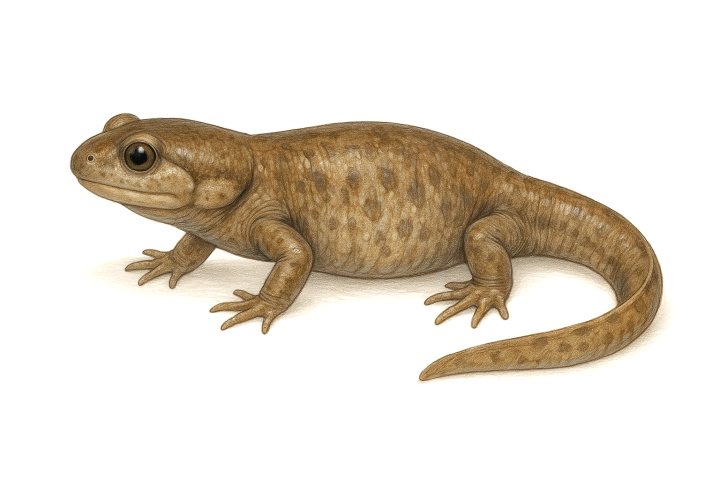
Meet the mole salamander — a stout little amphibian with a bit of a secretive streak. True to its name, this species spends most of its time underground, tucked beneath leaf litter or burrowed into soft soil. It’s not flashy, but it plays an important role in its ecosystem and has some fascinating tricks up its sleeve. One standout feature? Some populations never fully transform into land-dwelling adults and instead stay in their aquatic form for life. More on that below.
Size & Physical Appearance
Adult mole salamanders are on the smaller side, usually around 3 to 4 inches long, though some might stretch up to 5 inches. Their bodies are chunky with broad heads and short limbs, giving them a slightly toad-like appearance.
Their skin is typically a dull gray or brown, sometimes with blueish or silvery flecks. It’s not the most colorful salamander, but that cryptic coloration helps them blend in with the forest floor. Juveniles tend to look like mini adults, though brighter in color. Males and females look pretty similar, though males may appear a bit bulkier when breeding season rolls around.
Habitat and Range
Mole salamanders live in the Southeastern United States, with their range spreading from eastern Texas and Oklahoma eastward into Florida, and up to Kentucky and southern Illinois. They stick to lowland hardwood forests, especially those with access to seasonal or fish-free wetlands like vernal pools.
Because they rely on moist environments, you won’t typically find them in dry uplands or urbanized areas unless there are pockets of wetland habitat nearby. They’re most active at night and during wet weather, so sightings can be rare unless you know where (and when) to look.
Diet
In the wild, mole salamanders are opportunistic carnivores. They feast on small creatures like insects, worms, snails, and tiny crustaceans. Larval mole salamanders, which live in water, mostly eat aquatic invertebrates and other small critters they can catch.
What’s cool is that these salamanders are surprisingly good hunters considering their squat shape. Their thick heads help them muscle through leaf litter as they search for prey beneath the surface.
Lifespan
In the wild, mole salamanders can live about 8 to 10 years. In captivity, with good care, they might live even longer — potentially up to 15 years. Since they spend so much time underground, they’re relatively protected from predators and environmental extremes, which can help them live longer lives.
Identification Tips
Telling mole salamanders apart from similar species can be tricky, but there are a few key features to look for:
- Size and shape: Their body is short and thick with a broad head and relatively small eyes.
- Color: Dull gray or brown with specks — not bright or flashy like marbled or spotted salamanders.
- Habitat: If you’re finding a chunky salamander in a lowland forest near a vernal pool in the Southeast, mole salamander is a good bet.
- No distinct markings: Unlike the spotted salamander (Ambystoma maculatum), mole salamanders lack clear yellow or orange spots.
Larval mole salamanders can sometimes be mistaken for larvae of larger Ambystoma species, but they tend to retain their external gills into adulthood in some populations, which can throw people off. This leads us right into a fun fact…
Fun Fact
Some mole salamanders are neotenic, meaning they don’t go through the usual transformation into a land-based adult. They stay in their aquatic form for life — gills and all — and still manage to breed successfully. It’s like they hit the pause button on growing up and are totally fine staying in permanent water-teen mode.
This trait shows up more often in permanently wet environments where staying aquatic actually gives them an advantage.
Mole salamanders might not be the most photogenic amphibians out there, but they’re an important part of their ecosystem and packed with hidden charm. Whether you’re a student doing a biology report or a nature lover hoping to spot one in the wild, learning about this secretive species is well worth your time. Keep an eye out near wet forests and vernal pools — there’s a whole world of life happening just beneath your feet.