
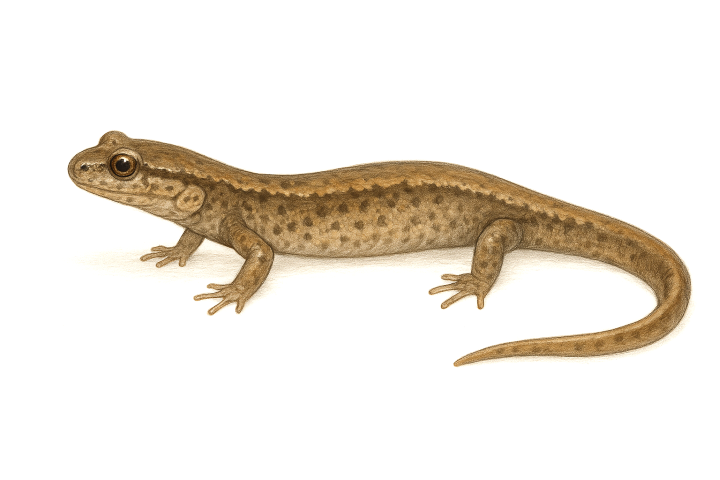
The Northern Dusky Salamander may not be the flashiest amphibian in the forest, but it’s a fascinating little creature once you know where to look. Known for its secretive habits and earthy colors, this salamander is a master of camouflage and a key part of many streamside ecosystems in the eastern United States. It’s also a great example of how even the smallest animals play big roles in nature.
Size & Physical Appearance
Adult Northern Dusky Salamanders usually measure between 2.5 to 5 inches long from nose to tail. Their colors range from brown to reddish-brown, sometimes with a mottled pattern or dark spots along the back. The underside tends to be lighter, often grayish-white.
One of the more subtle features is their coloration, which can vary slightly depending on habitat. Some individuals are darker, especially those living in shaded, forested stream areas. Juveniles often have a distinct light-colored line running from the eye to the jaw, which fades as they mature. Males and females look pretty similar, although during breeding season, males may have swollen glands near the base of the tail.
Habitat and Range
These salamanders rely on moist environments and are most commonly found in and around cool, clear streams, seeps, and springs. They prefer wooded areas and rocky, shaded habitats that provide lots of cover, like logs, leaf litter, and moss-covered rocks. You’re most likely to find them in eastern North America, especially in the Appalachian Mountains and surrounding areas. States with strong Northern Dusky populations include New York, Pennsylvania, Ohio, West Virginia, and parts of the southeast.
They’re pretty adaptable when it comes to elevation and can be found from lowland forests up into the lower mountain elevations—as long as there’s a moist, cool microhabitat nearby.
Diet
The Northern Dusky Salamander is a carnivore with a taste for the tiny. It feeds on a wide variety of small invertebrates, such as:
- Ants
- Beetles
- Spiders
- Worms
- Insect larvae
They’re opportunistic feeders, which means they’ll eat pretty much whatever small prey crosses their path—as long as they can catch it with their quick, sticky tongues.
Lifespan
In the wild, Northern Dusky Salamanders typically live around 4 to 8 years. In captivity, with proper care, they’ve been known to live a bit longer, even into the 10- to 15-year range. Like many small amphibians, their life expectancy depends heavily on environmental conditions and the availability of food and shelter.
Identification Tips
Here’s how to tell a Northern Dusky Salamander apart from other similar species:
- No distinct dorsal stripe: Unlike the Eastern Red-backed Salamander, Duskies generally lack a bold, straight line down their backs.
- Eye-jaw line: Juveniles and sometimes adults have a light stripe from the eye to the jaw.
- Laterally flattened tail: Their tail is slightly keeled or ridged, especially in aquatic individuals—this helps distinguish them from other terrestrial salamanders.
- Hind legs larger than front legs: A subtle giveaway, but their rear limbs are a bit more muscular and pronounced than the front ones.
If you’re flipping over rocks near a stream and something small, quick, and brown slips away—there’s a good chance it’s a Dusky.
Fun Fact
The Northern Dusky Salamander can breathe through its skin. It doesn’t have lungs! Because of this, it absolutely depends on a moist environment to survive. If their skin dries out, they can’t exchange oxygen properly—and that’s why you’ll almost never find one too far from water.
One more neat trick: they have a defense strategy where they’ll detach their tail if grabbed by a predator, distracting the attacker and giving the salamander a chance to escape. The tail eventually grows back!
Wrap-Up
While the Northern Dusky Salamander might not be the star of the amphibian world, it’s a quiet marvel of stream life. These little salamanders are important indicators of water quality and play a big role in controlling insect populations. If you’re out exploring a shaded creek in the eastern U.S., take a careful look under a log or rock—you just might meet a Dusky hiding in plain sight.