
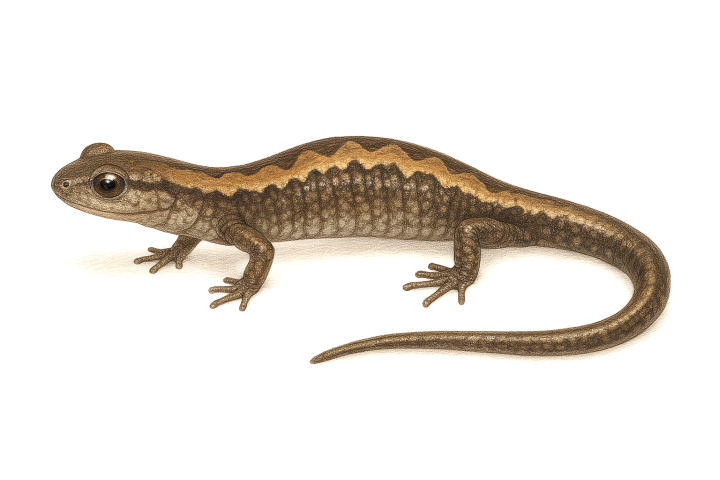
Meet the Northern Zigzag Salamander — one of nature’s little stealth artists. This small, secretive amphibian is known for its squiggly stripe that gives it its common name. While it might not be the flashiest creature on the forest floor, its quiet, quirky lifestyle makes it a fascinating find for nature fans and herp enthusiasts alike. If you’re hiking through the Appalachian foothills and spot a tiny salamander zigzagging under a log, you’ve probably just met one.
Size & Physical Appearance
Northern Zigzag Salamanders are small and slender. Adults usually range from about 2.5 to 4 inches long from snout to tail. Their bodies are typically dark brown or gray, with a distinctive zigzag or wavy stripe running down their back — usually in shades of red, orange, or yellow.
Interestingly, not every individual has that stripe. Some are what’s called a “lead-backed” morph, meaning their backs are solid dark gray instead of striped. These variations can happen in the same population, which makes it even more intriguing when you’re trying to ID them.
Males and females look pretty similar, but during the breeding season, males may have slightly swollen glands under their chins (called mental glands) that help them with courtship.
Habitat and Range
Northern Zigzag Salamanders are closely tied to forests — especially moist, shaded, deciduous woodlands with plenty of leaf litter, rocks, and rotting logs to hide under. They do not have lungs and breathe through their skin and the lining of their mouth, so staying damp is critical.
Their native range includes parts of the eastern United States, especially the central Appalachian region. You can find them in states like Indiana, Kentucky, Tennessee, Ohio, West Virginia, and parts of Illinois and Missouri.
They tend to prefer relatively low to moderate elevations, but will show up in hill country and rocky outcrops where conditions stay moist.
Diet
These salamanders are nocturnal insectivores and tend to hunt at night or during damp weather. Their typical menu includes:
- Small insects
- Spiders
- Mites
- Springtails and other tiny arthropods
Nothing too fancy — but they play an important role in keeping forest floor invertebrate populations in check.
Lifespan
In the wild, Northern Zigzag Salamanders can live up to 10 years or more, although most probably live slightly shorter lives due to predation and environmental risks. In captivity — with the right care and environment — they can potentially live even longer, but they’re not commonly kept as pets.
Identification Tips
It’s easy to mistake the Northern Zigzag Salamander for a few close relatives, especially if you’re in a state with overlapping ranges. Here’s what to look for:
- Zigzag or wavy stripe: That’s your biggest clue. It usually runs the full length of the back and is red, orange, or yellow. But remember — some individuals lack the stripe altogether.
- Toe count: These salamanders have five toes on their hind feet. Some similar species, like some in the Eurycea genus, have only four.
- Slender build and small size: Helps separate them from bulkier species like the Eastern Red-backed Salamander, even if their colors are similar.
When in doubt, location, stripe shape, and toe count can give you a pretty solid ID.
Fun Fact
Northern Zigzag Salamanders are part of the Plethodon genus, also known as the “woodland salamanders.” One unusual feature? They never have a larval stage in water. Instead, eggs hatch into tiny versions of adults — already fully formed for life on land. That means they never have gills or need a pond to grow up in!
That direct development allows them to live far from streams or ponds — which is rare for amphibians.
This little salamander might be easy to overlook, but it’s got a lot going on if you know what to look for. Next time you’re in the woods after a rain, turn over a rock or two — just be sure to put it back gently — and you might just catch a glimpse of this zigzagged local doing its thing.