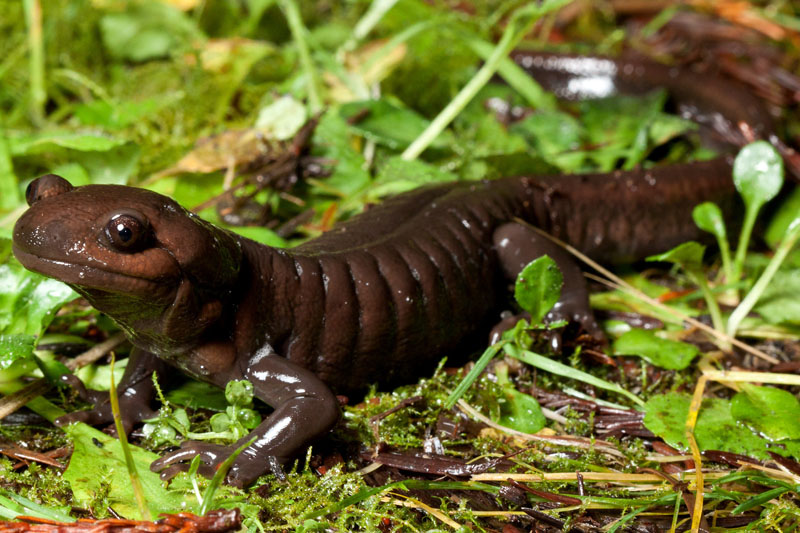
The Northwestern Salamander is a quiet, secretive amphibian that lives much of its life underground or hidden in forest debris — but it’s anything but boring. With its chubby body, smooth skin, and occasionally permanent aquatic lifestyle, this salamander is full of surprises. It’s also one of the few salamanders that can deliver a mild toxin through its skin as a defense mechanism, making it a bit of a tough customer in the amphibian world.
Size & Physical Appearance
Northwestern Salamanders are medium to large compared to other salamanders, typically measuring between 5.5 to 9 inches long. Their coloring can range from dark brown to black, sometimes with a dusky or grayish tone. Some individuals have faint speckling or yellowish spots, mostly on their back and tail.
Juveniles tend to be lighter and have more noticeable gills until they mature, while males develop swollen cloacal glands during the breeding season. One standout feature is their wide heads and robust bodies — they look kind of like cute little logs with legs.
In higher-elevation populations and colder environments, this species often retains its larval features even into adulthood — a condition known as neoteny. These individuals stay in the water, keeping their external gills and tail fins.
Habitat and Range
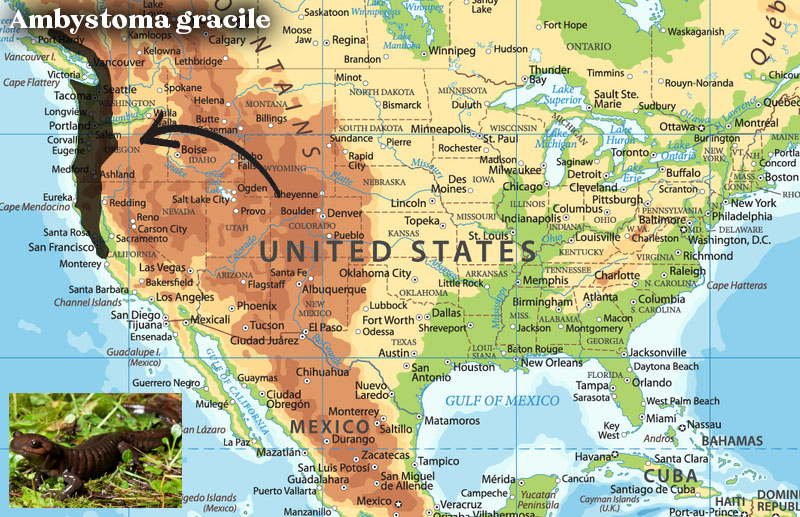
You’ll find Northwestern Salamanders in the damp forests of the Pacific Northwest. Their range stretches from southeastern Alaska through British Columbia and down into Washington, Oregon, and parts of northern California. They tend to stick to lowland coniferous and mixed forests, but they can also be found in areas up to about 6000 feet elevation.
They need moisture to thrive, so think dense forests with plenty of logs, mossy ground, and slow-moving water nearby. Adults are mainly terrestrial and live underground in rodent burrows or root channels, only coming to the surface on rainy nights or during the breeding season. Neotenic adults stay in ponds and lakes year-round.
Diet
These salamanders aren’t picky eaters. Their diet includes a variety of small invertebrates such as:
- Earthworms
- Slugs
- Insects and their larvae
- Spiders
Larval Northwestern Salamanders eat smaller prey like zooplankton, aquatic insects, and tiny crustaceans. Since they’re mostly ambush predators, they’ll just hang out and wait for something tasty to wander close.
Lifespan
In the wild, Northwestern Salamanders typically live for around 8 to 12 years. Some individuals have been known to reach 15 years or more, especially in stable aquatic environments. In captivity, when cared for properly, they can live even longer.
Identification Tips
This species can be tricky to tell apart from others in its range, but here are a few tips:
- Western Tiger Salamander: Has bold yellow or greenish blotches or bars. Northwestern Salamanders are more uniformly dark.
- Long-toed Salamander: Much smaller and has a distinct yellow or green stripe down its back with longer toes.
- Coastal Giant Salamander: Larger and has a rougher, more textured skin with speckling. Northwestern Salamanders have smoother skin.
If you come across a large, dark salamander with smooth skin, no obvious blotches, and a thick body — especially near a quiet pond surrounded by forest — there’s a good chance you’re looking at a Northwestern Salamander.
Fun Fact
When threatened, Northwestern Salamanders can secrete a sticky, whitish toxin from large glands on the back of their heads. This gooey substance may not be deadly, but it can definitely make a predator think twice — some birds have been seen wiping their beak on the ground after trying to snack on one!
Wrapping Up
The Northwestern Salamander might keep a low profile, but it plays a big role in the forest ecosystem. It helps control insect populations and serves as food for larger animals. Whether it’s living a hidden underground life or hanging out as a gilled adult in a mountain pond, it’s a fascinating example of amphibian adaptability.
If you’re exploring the Pacific Northwest and stumble across a damp forest trail or a quiet, tree-lined lake, keep a lookout — you might just spot one of these secretive salamanders. Just remember: look, don’t touch — and definitely don’t lick!