
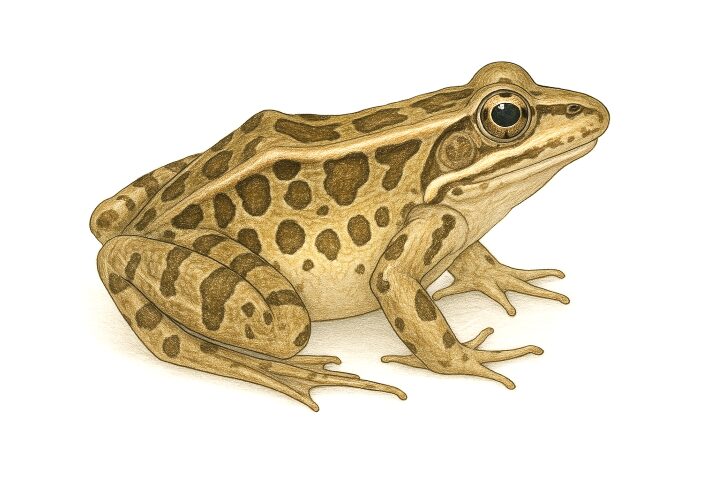
The Pickerel Frog might look like your average brown-spotted frog, but don’t let that fool you. It’s the only native frog in the United States known to produce toxic skin secretions — enough to deter some predators. Found in cool, clean streams and moist woodlands, this fascinating amphibian earned its name because its distinctive pattern reminded early naturalists of the chain-like markings on pickerel fish.
Let’s take a closer look at what makes the Pickerel Frog stand out.
Size & Physical Appearance
Pickerel Frogs are medium-sized, usually growing to about 2 to 4 inches in length. Their coloring can range from tan to light brown, and they have two prominent rows of dark rectangular spots running down their back — a key feature that helps identify them. The spots are often evenly spaced, almost in straight lines.
Their bellies are white or cream, and many have a splash of bright yellow or orange on the inner thighs — a flash of color you might catch if one hops away quickly.
Males are generally smaller than females and may have more vocal sacs during the breeding season. Juveniles look similar to adults but are paler, and their spots may be less distinct at first.
Habitat and Range
Pickerel Frogs prefer cool, clear water and moist environments. You’re most likely to find them near springs, seeps, slow-moving streams, and shaded wet meadows. They also hang out in forested wetlands and floodplain forests, especially in the northeastern U.S.
Their range covers a good chunk of the eastern and central United States, from eastern Canada down through the Appalachians and into parts of the Midwest and Southeast. States where they’re common include Pennsylvania, New York, Ohio, Kentucky, Tennessee, and Virginia. They’re much less common the farther south you go, as they tend to avoid areas with warmer or more stagnant waters.
Pickerel Frogs don’t do well in polluted waters — they’re a good indicator of clean, oxygen-rich streams and springs.
Diet
In the wild, Pickerel Frogs are bug specialists. They eat a variety of insects, spiders, and other small invertebrates, including beetles, ants, flies, and the occasional snail or worm.
They’re sit-and-wait predators, meaning they’ll stay still and ambush prey that wanders too close. In cooler weather, their activity slows down, and so does their appetite.
In captivity (though not commonly kept), their diet would include crickets and other small feeder insects with appropriate calcium supplementation.
Lifespan
In the wild, Pickerel Frogs typically live around 4 to 5 years, though some may reach up to 6 or 7 years in ideal conditions. In captivity — when cared for properly — they can live slightly longer, though they’re not as popular as pets compared to other frog species.
Identification Tips
It’s easy to confuse Pickerel Frogs with Leopard Frogs — particularly the Northern Leopard Frog, which shares much of the same range.
Here’s how to tell them apart:
- Spot shape: Pickerel Frogs have square or rectangular spots in neat rows. Leopard Frogs have rounder, more randomly placed spots.
- Thigh color: Pickerel Frogs often have bright yellow or orange inner thighs; Leopard Frogs do not.
- Color contrast: Pickerel Frogs tend to appear duller brown or tan, while Leopard Frogs have more contrast between the spots and background color.
- Toxicity: If you handle a Pickerel Frog and notice a bitter or irritating residue on your hands, that’s a hint — Leopard Frogs don’t produce toxins, but Pickerel Frogs do.
If you’re still unsure, observe them carefully from a distance — remembering that amphibians absorb toxins through their skin and should always be handled with clean, wet hands (if at all).
Fun Fact
Pickerel Frogs secrete a mild toxin through their skin that can irritate predators — and sometimes humans too! While it’s not dangerous unless ingested or rubbed near the eyes or mouth, it’s enough to make some snakes turn up their noses. This natural chemical defense is part of what makes them unique among American frogs.
It also means Pickerel Frogs are less likely to be eaten by fish and other typical frog predators, giving them a bit of an edge in the wild.
Wrap-Up
The Pickerel Frog may not sing the loudest or come in wild neon colors, but this quiet creature has its own story to tell — from orderly spots to a clever chemical defense. If you’re out near a clean stream in the eastern U.S., keep your eyes peeled for a flash of yellow legs hopping into the brush. Just remember to admire with your eyes and not your hands.
They’re small, secretive, and proof that even common frogs can be full of surprises.