
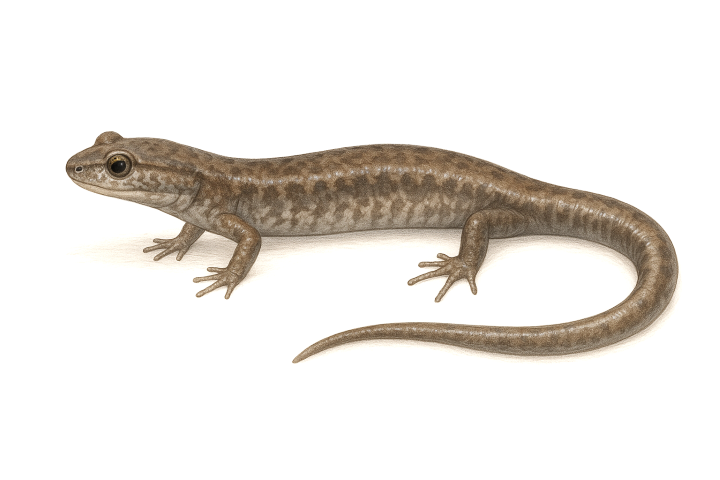
Tucked away in the forested hills and shady ravines of the Appalachian region, the Ravine Salamander is a quiet resident of the leaf litter layer. What makes it especially interesting? Unlike many salamanders, it doesn’t have lungs — it breathes entirely through its skin and the lining of its mouth. This makes a moist environment critical for its survival. It’s a secretive species, rarely seen unless you’re flipping over rocks or logs in just the right spot.
Size & Physical Appearance
Ravine Salamanders are small and slender. Adults typically measure between 3 to 4.5 inches in total length, including the tail.
Their bodies are a dark brown or blackish color, often highlighted by fine silvery or brassy flecks along their back and tail. These flecks can give them a subtle shimmer in the right light. Their underside is usually a lighter gray and less boldly marked. Males and females look fairly similar to the casual observer, though males may have slightly broader heads during the breeding season. Juveniles look like smaller adults, though their markings might not be fully developed yet.
Despite their somewhat plain appearance, their sleek, worm-like shape and iridescent speckling give them a certain understated charm.
Habitat and Range
True to its name, the Ravine Salamander is most often found on steep forested slopes, wooded ravines, and moist hillsides. It likes areas where the soil is rich and loose — easy to burrow into — and where there’s heavy leaf litter or plenty of rocks, logs, or bark to hide beneath.
This species is terrestrial year-round, meaning it doesn’t return to water to breed like many salamanders. Instead, it lays eggs on land and bypasses the aquatic larval stage entirely.
Ravine Salamanders are found mainly in the central and southern Appalachian Mountains. Their range includes parts of Ohio, Kentucky, West Virginia, Virginia, and Tennessee. They’re mostly seen at middle elevations, in cool, forested areas that stay damp throughout the year.
Diet
In the wild, Ravine Salamanders feed on a variety of tiny invertebrates. Their menu includes:
- Springtails
- Mites
- Tiny ants
- Small beetles
- Spiders
Basically, if it’s small, soft-bodied, and crawling around in the leaves, this salamander might eat it. Because they’re lungless, they have to stay moist — and that lines up perfectly with the damp environments where their prey also thrives.
Lifespan
In the wild, Ravine Salamanders are known to live at least 5 to 10 years, though accurate data is hard to come by since they’re so hard to track. In captivity, if kept under proper conditions, they may live slightly longer, but this species is not commonly kept in the pet trade.
Identification Tips
It’s easy to confuse the Ravine Salamander with a few of its close relatives, especially the Northern Slimy Salamander or the Southern Two-lined Salamander.
To tell them apart:
- Ravine Salamanders have a uniformly dark body with fine flecks — no bold stripes or rows of spots.
- Unlike the Southern Two-lined Salamander, Ravine Salamanders don’t have distinct yellow and black stripes down their back.
- Compared to the Northern Slimy Salamander, which has more noticeable large white spots and often a chunkier build, Ravine Salamanders are slimmer and have a more uniform look.
A key clue is behavior and location: if you’re in a shady ravine flipping over logs on a hillside, you’re right in Ravine Salamander territory.
Fun Fact
The Ravine Salamander has a pretty neat trick for escaping predators — it can drop its tail when threatened. The wriggling tail distracts would-be hunters while the salamander makes a getaway. Don’t worry, it can grow the tail back over time, although it’s never quite as perfect as the original.
Whether you’re a student on a salamander scavenger hunt or a hiker who came across a tiny, gleaming critter under a log, the Ravine Salamander is a cool example of Appalachia’s hidden biodiversity. Quiet, graceful, and a little mysterious, it’s a reminder of the tiny creatures that thrive in places most people overlook.