
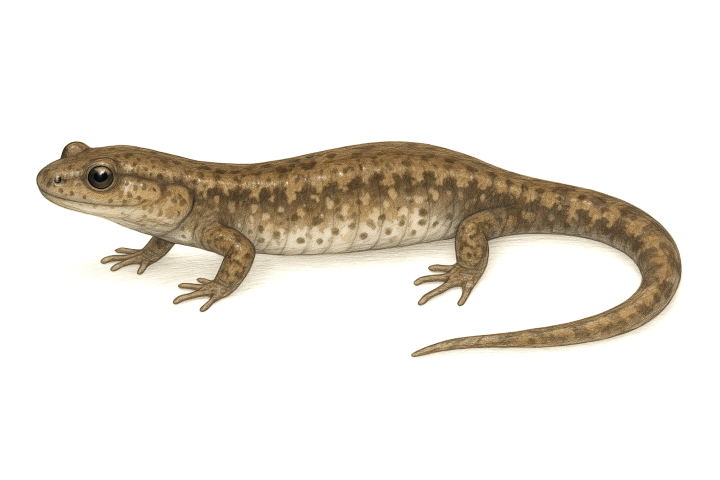
The Southern Appalachian Salamander is a secretive, lungless amphibian that lives high in the cool, misty mountains of the southeastern United States. It’s known for its striking, dark beauty and its important role in forest ecosystems. What makes this species stand out is its unique habitat preferences and its place in the complex web of salamander biodiversity in the Southern Appalachians — one of the most salamander-rich regions on Earth.
Size & Physical Appearance
These salamanders are medium-sized, usually reaching about 4 to 6.5 inches in total length, including the tail. Their bodies are a rich black or dark brown, often with a sprinkling of silvery or brassy flecks, especially along the sides.
The belly is typically lighter, sometimes grayish, and unmarked. Their skin is smooth and moist, like most woodland salamanders. Males and females look pretty similar, although males may have slightly more pronounced tail bases during breeding season. Juveniles resemble miniature adults but may lack some of the adult’s metallic flecking.
Habitat and Range
The Southern Appalachian Salamander lives in high-elevation hardwood and mixed forests, often in cool, moist areas with plenty of rotten logs, leaf litter, and moss-covered rocks. It’s most active on rainy nights or during high humidity, when the forest floor stays moist.
This species is found primarily in the Southern Appalachian Mountains, especially western North Carolina, eastern Tennessee, and parts of north Georgia. It prefers elevations between 2,000 and 6,000 feet, often overlapping with other Plethodon species — which makes identification a bit tricky.
Diet
Like many woodland salamanders, this species is an opportunistic feeder. It eats a variety of small invertebrates, including:
- Springtails
- Mites
- Ants
- Small beetles
- Spiders and other small arthropods
Because they’re lungless (they breathe through their skin and mouth lining), they stay hidden in moist environments and hunt primarily at night or during wet conditions.
Lifespan
In the wild, Southern Appalachian Salamanders can live around 8 to 10 years, possibly longer. Like many plethodontids, they grow slowly and can be quite long-lived for a small amphibian, especially in stable, undisturbed habitats. In captivity, they may live even longer with proper care, though they’re not common in the pet trade.
Identification Tips
This species can be tricky to tell apart from others in its genus, especially the closely related Red-cheeked Salamander (Plethodon jordani) and other mountain Plethodon species like the White-spotted or Cheoah Bald Salamander.
Key features to look for:
- Color: Solid dark body with silvery or brassy speckling along the sides
- No prominent side stripe like you’d see in the Eastern Red-backed Salamander
- Smooth skin and rounded tail (not keeled, like in some other species)
- Habitat location: Found at higher elevations in the southern Appalachians
It’s worth noting that this species often overlaps with others and hybridization may occur, so sometimes even experts have to rely on genetic tests for accurate IDs.
Fun Fact
Southern Appalachian Salamanders are lungless, which means they absorb oxygen directly through their skin. To breathe, they need to keep their skin moist — which is why you’ll usually find them under rocks or logs, especially in shady, damp forests. They’re also fiercely territorial for their size and will defend their space from other salamanders using head-butting and body posturing. It’s small-scale drama right under your feet!
Spotted one of these highland beauties? If you’re out hiking in the southern Appalachian forests and happen to lift a log or rock (always put it back carefully!), keep an eye out for this dark, glittering salamander. Watching them move like little forest shadows is a special experience — just be sure to view with care and avoid handling them, since their skin is sensitive and essential for breathing.