
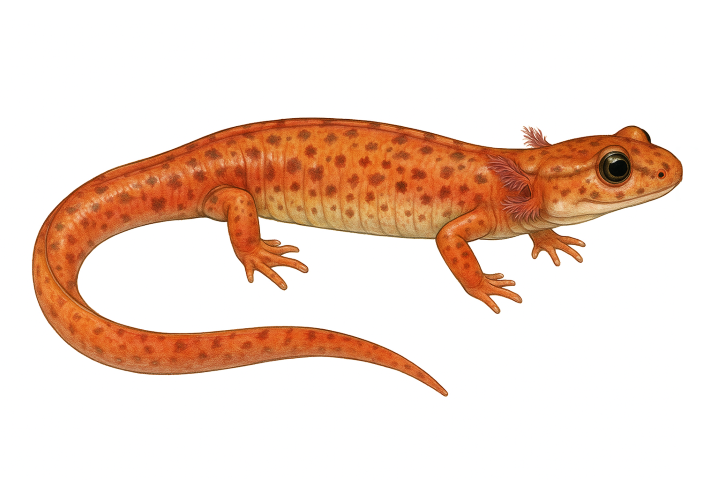
If you ever find yourself flipping over a rock in a cool, forested stream in the eastern U.S., you might get lucky and spot the sleek, pinkish-orange body of the Spring Salamander. This striking amphibian is a real standout among stream-dwelling salamanders—brightly colored, secretive, and a little mysterious. It prefers cold, clean water and is often a sign of healthy ecosystems. Plus, it’s one of the larger lungless salamanders you’ll find in the United States.
Size & Physical Appearance
Spring Salamanders are among the bigger salamanders in their family. Adults typically measure between 4 to 7.5 inches long, though some can get close to 8 inches.
They’re easily recognized by their
- pinkish, salmon, or reddish-orange color,
- scattered darker spots or mottling along the back and sides, and
- a faint, lighter-colored stripe that runs from the eye to the nostril.
Their tails are keeled (flattened side to side), which helps them move smoothly through water. Juveniles tend to be darker and duller, with shorter legs and more prominent tails. Males and females look similar, but during breeding season, males may show slightly swollen cloacal areas.
Habitat and Range
Spring Salamanders are creatures of the Appalachian region and other mountainous or hilly parts of the eastern United States. You’ll mostly find them in:
- clear, cold, rocky streams
- springs and seepages
- underground caves (in some parts of their range)
They prefer heavily wooded areas at mid to high elevations, usually up to around 4000 feet above sea level.
Geographically, their range includes parts of:
- New England (like Vermont and New Hampshire)
- the Appalachian Mountains (through Pennsylvania, West Virginia, Virginia, and the Carolinas)
- as far south as northern Georgia and Alabama
They don’t wander far from running water, so you’re most likely to find them tucked under rocks or logs near streambanks.
Diet
Spring Salamanders are carnivores with a taste for invertebrates. Their diet includes:
- small insects
- earthworms
- spiders
- aquatic larvae like mayflies or caddisflies
- and even smaller salamanders
Yes, they can be a bit sinister—larval Spring Salamanders are known to prey on the larvae of other salamander species. As adults, they’re ambush hunters, lying in wait and snapping up prey with lightning-fast movements.
Lifespan
In the wild, Spring Salamanders are thought to live around 7 to 10 years, although some individuals may live longer under ideal conditions. In captivity, they might surpass this, but they’re sensitive to changes in water quality and temperature, which makes long-term care tricky.
Their larval stage can be surprisingly long—3 to 6 years in some cases—depending on the water temperature and elevation. That’s a pretty big chunk of their life spent as aquatic larvae.
Identification Tips
Spring Salamanders can look similar to other stream-dwelling species, particularly the Northern Dusky or Two-lined Salamander. Here’s how to tell them apart:
- Size: Spring Salamanders are larger than both those species, often by a couple of inches.
- Color: Their pinkish or salmon color stands out. Dusky Salamanders are usually dark brown or gray, and Two-lined Salamanders are yellowish with two obvious black stripes.
- Nose stripe: The faint light line from eye to nostril is a helpful clue for Spring Salamanders.
- Flattened tail: Their laterally compressed tail looks a bit like a little paddle and helps separate them from other slender salamanders.
Fun Fact
Spring Salamanders breathe entirely through their skin—they have no lungs! This means they rely on moist environments to survive. The cleaner and colder the water, the better, which is why they’re considered a good indicator species for healthy headwater streams.
In the Field
If you’re hiking near cold mountain streams and curious about amphibians, slow down and look under streamside rocks or logs (just make sure to put them back gently). Spring Salamanders are sensitive to disturbance and pollution, so please avoid handling them with dry hands or disturbing their habitat too much.
They’re beautiful animals you don’t see every day, and their glowing, peachy color can almost seem unreal when you catch a glimpse. They’re also nocturnal and shy, so seeing one can feel like winning a little nature lottery.