
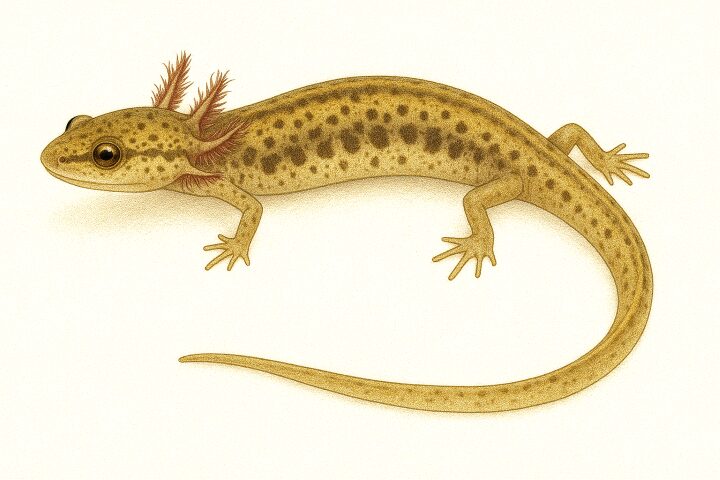
The Texas Salamander is a rare and mysterious little amphibian that lives its whole life underground — literally. This fully aquatic species is found in only a handful of springs and cave systems in central Texas, and it’s uniquely adapted to that hidden world. With its pale pink body, feathery external gills, and near-complete lack of eyes, the Texas Salamander looks more like a creature from science fiction than something you’d find in your backyard. If you’re into weird and wonderful wildlife, this one definitely makes the list.
Size & Physical Appearance
Texas Salamanders are small and slender, typically growing between 1.5 and 3 inches long. Their bodies are pale pink or translucent, often with faint speckling or no pattern at all. Because they live in total darkness, they don’t need pigment for camouflage — or eyes, really. Adults retain their larval features, like external red gills and slightly flattened tails designed for swimming. This condition is called neoteny, and it’s part of what makes this species so unusual.
They don’t have visible eyes, just small dark spots under the skin where eyes would normally be. Males and females look pretty similar, though males may develop slightly swollen glands during the breeding season.
Habitat and Range
The Texas Salamander has one of the most restricted ranges of any amphibian in the U.S. It’s found only in a few cave and spring systems in the Edwards Plateau region of central Texas, particularly in Bexar County around the San Antonio area.
These salamanders live in water inside caves or just outside cave openings, always in cool, clear, oxygen-rich spring water. They’re often found in underground crevices, especially in karst limestone aquifer systems. They never leave the water and don’t come to the surface, so they’re pretty hard to spot.
Diet
Because they live underground, Texas Salamanders eat small invertebrates that share their cave habitats. Their diet includes tiny aquatic insects, crustaceans, and other small prey they can detect using smell and movement — not sight.
One interesting thing is that they’re ambush predators. They wait in the dark for prey to get close, then strike with surprising speed. Their world may be quiet and dim, but their hunting game is strong.
Lifespan
In the wild, the exact lifespan of the Texas Salamander is not fully known due to the difficulty of studying them in their natural setting. However, other Eurycea salamanders can live around 10 to 15 years in captivity. It’s reasonable to guess they may live at least that long in the wild under stable conditions.
Identification Tips
At a glance, you might confuse the Texas Salamander with other related salamanders like the Barton Springs Salamander (Eurycea sosorum) or the San Marcos Salamander (Eurycea nana), especially since they’re all small, pale, and aquatic.
But here’s how to tell them apart:
- Texas Salamanders have vestigial (non-working) eyes covered by skin. Others, like the Barton Springs Salamander, have fully formed eyes.
- The Texas Salamander is also more commonly found in underground or cave environments, whereas some look-alikes live in open spring areas.
If you’re near San Antonio and you spot a pinkish, gilled salamander lurking in an underground stream or spring opening — chances are, it’s this one.
Fun Fact
This salamander never goes through full metamorphosis. It keeps its larval features — like those frilly external gills — throughout its entire life. That means it never really “grows up” in the traditional amphibian sense. Talk about commitment to the aquatic lifestyle!
Why It Matters
The Texas Salamander is not just interesting — it’s also important. Because it lives in groundwater systems, its health is a direct indicator of water quality in the aquifer. What happens to this species can tell us a lot about the health of the underground water Texans depend on. That makes conservation efforts for this salamander bigger than just one species — they’re about protecting an entire ecosystem.
So even if you never see one in person, this rare little cave dweller is playing a quiet but vital role in Texas.