
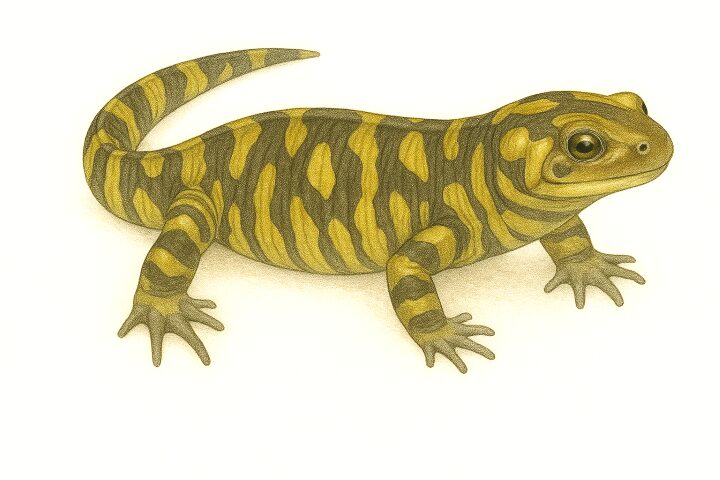
The Tiger Salamander is one of the largest and most striking salamanders in the United States. True to its name, it’s known for its bold, tiger-like stripes or blotches and its chunky, almost cartoonish body. You probably won’t stumble across one without really looking — these guys are masters of hide-and-seek, spending most of their time underground. But when they do show up, they make a lasting impression.
Size & Physical Appearance
The Tiger Salamander is a big amphibian. Adults typically range from 6 to 8 inches long, but some can grow up to 13 inches — making them one of the biggest land-dwelling salamanders in North America.
Their color pattern is truly eye-catching: a dark brown, black, or olive background covered in bright yellow or greenish blotches or bars. No two individuals look exactly alike. Some look more like they have stripes; others are all blotchy.
Juveniles, called metamorphs, are smaller and usually duller in color. Males tend to have longer tails and more prominent cloacal glands (that’s an opening under the tail used during mating). If it’s breeding season and the salamander seems especially robust with a longer tail base, it’s likely a male.
Habitat and Range
Tiger Salamanders live in a surprisingly wide range of habitats. You’ll find them in forests, grasslands, meadows, and even deserts — as long as there’s loose soil for them to burrow and seasonal ponds or wetlands for breeding.
They’re pretty widespread across the United States and are native to most of the central and western U.S., from parts of New York and the Midwest all the way to California and down into Texas and northern Mexico. They’re also found at a variety of elevations, from lowland river valleys to alpine meadows.
These salamanders are known as fossorial animals, which means they spend most of their adult lives underground in burrows — sometimes burrowing over two feet deep.
Diet
Tiger Salamanders are opportunistic carnivores. Out in the wild, they’ll eat just about anything they can catch and swallow. Their diet includes:
- Insects
- Worms
- Slugs
- Small frogs
- Even other salamanders (yes, they can be a bit cannibalistic)
Larvae are aquatic and will feed on aquatic invertebrates, tadpoles, and sometimes each other.
In captivity, they’ll readily eat crickets, mealworms, and earthworms, though it’s best to offer them a varied diet.
Lifespan
In the wild, Tiger Salamanders can live for about 10 to 15 years, though many don’t make it that long due to predators or habitat issues. In captivity, with good care, they may live even longer — sometimes 20 years or more.
Identification Tips
Tiger Salamanders can be confused with similar species, especially Barred Tiger Salamanders (a subspecies) or other large mole salamanders in the genus Ambystoma. Here’s how to tell them apart:
- Tiger Salamanders usually have bold blotches or bars over a dark body. Their markings tend to be more irregular and larger.
- Spotted Salamanders have smaller yellow or orange spots arranged in neat rows — not chunky blotches.
- Mole Salamanders (like the Eastern Mole Salamander) are smaller and plainer in color, usually a solid bluish-black with tiny specks.
Also, keep in mind that because of regional subspecies (like the Eastern, Western, and Barred Tiger Salamanders), exact coloration can vary quite a bit.
Fun Fact
Some populations of Tiger Salamanders stay permanently aquatic and retain their gills into adulthood — this is called neoteny. These salamanders look a lot like axolotls and never lose their larval features, even as they become full-grown adults. How wild is that?
If you’re lucky enough to spot a Tiger Salamander in the wild, consider it a rare treat. These impressive amphibians are often heard more than seen — especially during rainy spring nights when they migrate to breeding ponds. Just be sure to admire from a respectful distance and help keep their secretive world safe.