
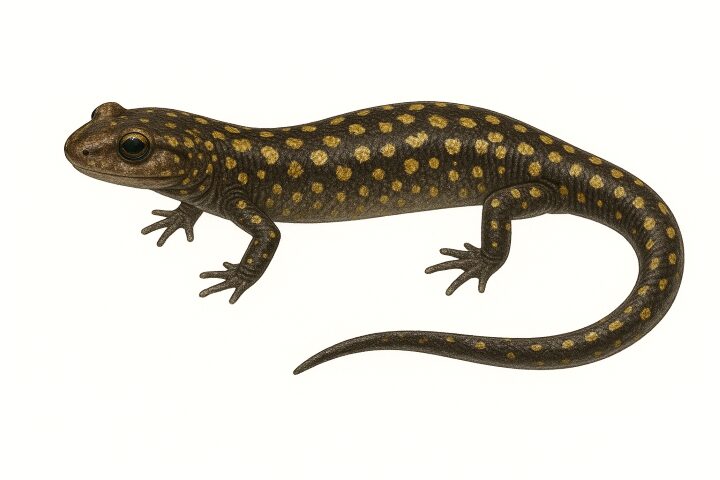
If you’re exploring the misty forests of the Appalachian Mountains and happen to lift a rock or a log, you might be lucky enough to meet the charming Weller’s Salamander. This little amphibian is a mountain specialist, known for its striking markings and extremely limited range. What makes it stand out? This salamander has a narrow home range, doesn’t have lungs (yep, it breathes through its skin), and sticks to the cool, moist mountaintops of the southern Appalachians. It’s also considered a species of conservation concern — more on that in a minute.
Size & Physical Appearance
Weller’s Salamanders are small, reaching about 2.5 to 4 inches in length, including their tail. They have a dark, nearly black body speckled with bright brass or silvery white flecks across their back and sides — kind of like someone dusted them with glitter. Juveniles tend to have brighter, more defined spots than adults, and over time these markings may fade slightly.
Males and females look pretty similar, though males usually have slightly wider heads and may show subtle swelling around the jaws during breeding season. Still, unless you’re holding one under magnification, those differences are tough to spot.
Habitat and Range
This salamander is a true mountain dweller. It’s found only at higher elevations, typically above 4,000 feet, and sticks to cool, shaded forests with lots of moss, leaf litter, and large rocks or logs for shelter.
The species is endemic — meaning it’s found nowhere else — to a very small part of the southern Appalachian Mountains. Specifically, populations are known from high-elevation areas in North Carolina, Tennessee, and Virginia. Because its range is so limited and fragmented, it’s highly sensitive to habitat change. Even minor disturbances can have a big impact on local populations.
Diet
Like most woodland salamanders, Weller’s Salamander has a relatively simple but effective diet. It feeds on small invertebrates — think tiny insects, mites, springtails, and other critters crawling around in the leaf litter. It hunts mostly at night or during moist, overcast days when conditions are damp.
No fancy hunting tactics here — it just uses its sticky tongue to snag prey that’s small enough to swallow and not fast enough to escape.
Lifespan
In the wild, Weller’s Salamanders are believed to live around 8 to 10 years, though exact numbers are hard to pin down due to their secretive nature. In captivity, they could potentially live even longer, though captive studies are limited, and this salamander isn’t commonly found in the pet trade (mostly due to legal protections).
Identification Tips
Weller’s Salamander can be confused with other small, dark Plethodon species, especially those that also live in the Appalachian Mountains. Here’s how to tell them apart:
- Color pattern: Weller’s has sharp, silvery or brassy flecks on a black background. Other species, like the Red-backed Salamander, usually have a solid stripe or lack the speckled look altogether.
- Range: Because Weller’s is found in only a few high-elevation sites, where you see the salamander can be a strong clue. If you’re not in the higher elevations of the southern Appalachians, it’s probably not a Weller’s.
- No red or stripes: Weller’s doesn’t show the red backs or striped markings that are common in Eastern Red-backed or Southern Two-lined Salamanders.
If you’re not sure what you’re looking at, take a photo and compare it with a regional field guide — or better yet, use a citizen science app like iNaturalist to get help from the community.
Fun Fact
Unlike many salamanders that breed in ponds and lay eggs underwater, Weller’s Salamanders skip the water entirely. They practice something called direct development, which means the babies hatch from eggs laid on land and come out looking like tiny adults — no tadpole stage required. That’s a huge advantage in a mountaintop world where standing water is limited and predators are always lurking.
It’s just one more way this species has adapted to life in the highlands.
Final Thoughts
Weller’s Salamander is a gem of the Appalachian Mountains — small, secretive, and completely unique to its mountaintop home. With climate change and habitat disruption threatening high-elevation ecosystems, protecting this species means protecting a whole world of mountain life that depends on cool, moist forests.
If you’re hiking in their range, tread lightly, resist flipping rocks (or at least put them back exactly how you found them), and enjoy knowing these tiny salamanders are living treasures worth looking out for.