
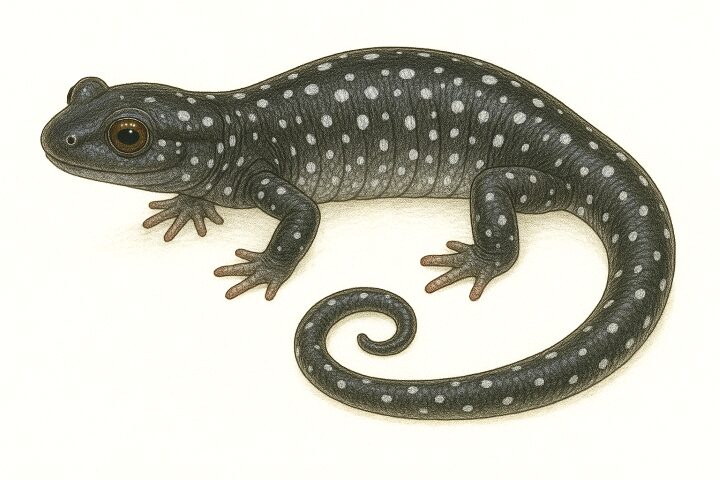
The White-spotted Slimy Salamander is a quiet little resident of the southeastern U.S., often hiding under rocks, logs, or in the leaf litter of shady forests. It’s part of the lungless salamander family, meaning it actually breathes through its skin and the lining of its mouth — pretty wild, right?
One of its most unique traits is hinted at in the name: this salamander produces a sticky, slimy substance as a defense mechanism. If you’ve ever handled one gently and ended up with a bit of goo on your fingers, now you know why.
Size & Physical Appearance
The White-spotted Slimy Salamander is a medium-sized salamander, usually ranging from 4 to 6.5 inches long, though some can push a bit beyond that.
Color-wise, it’s mostly shiny black with a pattern of white or silvery spots scattered across its sides, back, and tail. The spots can vary a lot in size and number — which sometimes makes it confusing to identify. Juveniles generally look similar to adults but may have fewer spots, and their skin often has a more delicate, almost velvety appearance.
Males and females look alike to most eyes, though researchers can distinguish them more easily during breeding season when males develop slight changes in their cloacal glands.
Habitat and Range
These salamanders are real fans of moisture and shade. They live in hardwood forests, often in the Appalachian and Piedmont regions where mature trees and plenty of ground cover help keep things damp.
You’ll find them in the southeastern United States, especially in states like Virginia, North Carolina, South Carolina, Georgia, and parts of Alabama and Tennessee. They usually hang out at elevations ranging from sea level up to about 3,000 feet, but are most common in higher, cooler forests where the humidity is just right.
They avoid super-wet places like swamps and streams, preferring well-drained forest floors, where they can tuck away under logs or stones and stay hidden during the day.
Diet
White-spotted Slimy Salamanders are carnivorous and not too picky. They dine on a variety of invertebrates, such as:
- Ants
- Beetles
- Spiders
- Earthworms
- Millipedes
They use what’s called a projectile tongue to snap up prey, which is a lot like how a frog catches insects. For a creature that spends most of its life hidden, it’s surprisingly good at hunting.
Lifespan
In the wild, these salamanders can live up to 10 years, though it’s not uncommon for individuals to reach only 5 to 7 years. In captivity, with optimal care, they’ve been known to live even longer.
Identification Tips
This species can be tricky to ID because several other slimy salamanders look very similar. Here are a few ways to help tell them apart:
- White or silvery spots are more or less evenly scattered across the back and tail (though individual markings vary).
- Compare it to the Northern Slimy Salamander — which tends to have more spots grouped together and a range farther north.
- The Wightman’s Slimy Salamander (found in nearby regions) may overlap, but looks darker and less spotted.
If you’re in the Carolinas or Virginia, you’ve got a good shot it’s the White-spotted.
Fun Fact
The “slimy” defense is no joke — when threatened, this salamander oozes a sticky secretion that can gum up the mouth of potential predators. It’s even strong enough to glue a snake’s jaws shut for a moment, buying the salamander precious time to slip away.
Also, like all Plethodontid salamanders, they breathe through their skin — which means they need a moist environment to survive. That’s one big reason you’ll never find them basking out in the sun.
Quick Takeaways
- Size: About 4 to 6.5 inches long
- Looks: Black with scattered white or silvery spots
- Lives: Shaded, moist forests in the southeastern U.S.
- Eats: Insects, worms, and other invertebrates
- Breathes: Through its skin — no lungs!
- Defense: A sticky slime secretion that gums up predators
This is one of those creatures that might be all around you in the woods, even if you never see it. Next time you’re on a hike and flip over a well-placed log or stone (always carefully and respectfully, and be sure to put it back), you might just get a glimpse of this slippery, speckled salamander.