
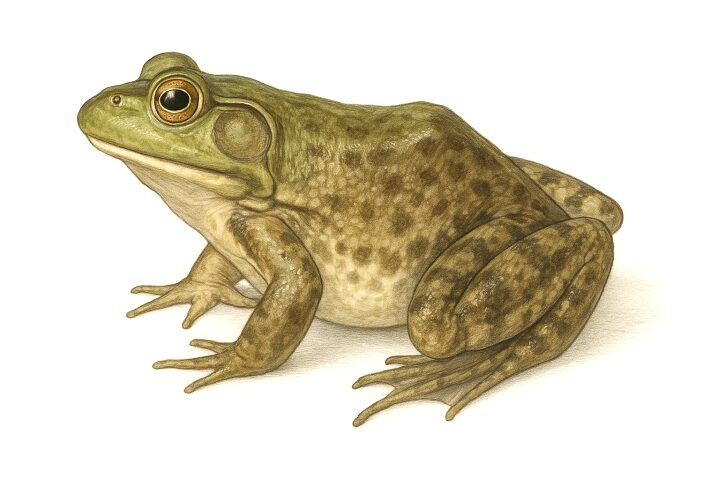
The American Bullfrog is North America’s largest native frog and probably the one you’re most likely to hear before you see. That deep, bellowing call that sounds like “jug-o-rum”? Yep, that’s a bullfrog. They’re bold eaters, excellent jumpers, and surprisingly good at blending in despite their size. Whether you’re exploring a farm pond, a marsh, or your local park’s creek, there’s a good chance these big frogs are nearby.
Size & Physical Appearance
American Bullfrogs are true giants among frogs in the U.S. Adults usually measure between 3.5 to 6 inches from snout to vent, but legs and all, they can stretch up to 8 inches or more. And some real bruisers can weigh over a pound.
They’re typically green to olive green on top, with a lighter belly that might be white, yellowish, or lightly mottled. Some may have darker blotches, especially on their legs. Males can often be told apart from females by their bright yellow throats and enormous tympanum discs (that’s the round eardrum-looking thing behind the eye), which are much larger than their eyes. In females, the tympanum is about the same size as the eye.
Juveniles look similar to adults but smaller and usually don’t have as much distinctive throat coloring.
Habitat and Range
American Bullfrogs love water. They’re commonly found in ponds, lakes, slow-moving streams, swamps, and marshes, especially where there’s plenty of vegetation for cover. As long as there’s standing or slow-moving water, bullfrogs will likely make themselves at home.
They’re native to the eastern two-thirds of the U.S., from the East Coast west to roughly the Rocky Mountains. However, due to introductions (both accidental and intentional), they’ve now spread across most of the continental U.S., including the Pacific Coast.
They’re known to do well from sea level up to about 7,000 feet in elevation, depending on the state and climate.
Diet
Bullfrogs are not picky eaters — in fact, they’ll eat just about anything they can overpower and fit in their mouth. Their typical diet includes:
- Insects like beetles, flies, and moths
- Other frogs (yes, even their own kind!)
- Crayfish, small snakes, and small birds
- Occasionally small mammals like mice
They are ambush predators, meaning they wait quietly and spring forward with lightning speed when something tasty comes by. Their powerful legs and wide mouth make them surprisingly effective hunters.
Lifespan
In the wild, American Bullfrogs typically live about 7 to 9 years, although many don’t make it past the tadpole stage due to predation. In captivity, with good care, they can live over 10 years.
Identification Tips
Trying to tell a bullfrog from other green frogs like the Green Frog (Lithobates clamitans)? Here are a few tips:
- Size: Bullfrogs are much bigger than other native frogs.
- Dorsal ridges: Unlike the Green Frog, bullfrogs do not have ridges that run down their back from behind the eye. Instead, their ridges curve around the tympanum (eardrum) and stop.
- Call: Their deep bellowing call (“jug-o-rum”) is much lower and louder than other frogs.
- Mouth: A bullfrog’s mouth is downright massive for a frog and looks proportionally huge on younger individuals.
Fun Fact
Bullfrogs have been known to leap six feet in a single bound — that’s like a human jumping the length of a school bus in one hop!
Wrapping Up
If you spend time near water in the United States, especially in the summer, chances are good you’ve heard a bullfrog. They’re a big part of pond ecosystems, and while their predatory nature can sometimes make them hard on other amphibians (especially when introduced outside their native range), they’re also fascinating animals that draw a lot of attention.
Perfect for nature walks, science projects, or just good old-fashioned frog watching, the American Bullfrog is a great ambassador for how interesting amphibians can be. Just keep your distance and don’t try to relocate them — their impact on non-native ecosystems can be pretty serious.
Happy frogging!