
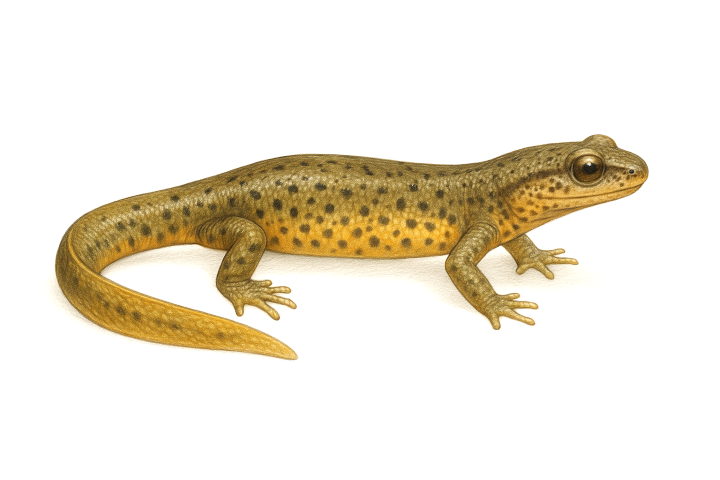
The Columbia Torrent Salamander (Rhyacotriton kezeri) is a small, secretive amphibian that’s perfectly adapted to life in the cold, fast-moving streams of the Pacific Northwest. What makes this salamander truly unique is its love for icy mountain waters that many other amphibians would avoid. With a bright yellow belly and an almost lizard-like appearance, it’s one of those hidden treasures you’d be lucky to spot on a hike.
If you’re a fan of wild corners and clean mountain creeks, this is an amphibian to appreciate. It’s not flashy, but it’s fascinating.
Size & Physical Appearance
Columbia Torrent Salamanders are small — adults typically range from 2.5 to 4.5 inches long, including the tail. Their bodies are slender with a relatively short tail compared to other salamanders.
They usually have a yellow to yellow-orange belly sprinkled with dark spots. Their backs are usually olive-brown or tan, often mottled with darker patches. One of their most distinctive traits is the short, square snout and large eyes that give them a wide-eyed look.
Males may have slightly swollen cloacal areas and larger premaxillary teeth (used during courtship), but otherwise, males and females look pretty similar. Juveniles look like miniature adults but can have paler coloring.
Habitat and Range
This salamander has a very specific address: coastal stream systems in southwestern Washington and northwestern Oregon. It’s found at elevations ranging from sea level to around 1,000 feet, especially in the moist coastal forests of the Pacific Northwest.
What it really loves are cold, well-shaded, fast-flowing streams with rocky bottoms. You’ll most often find it near seeps, springs, and the trickles of water that run down mossy slopes in old-growth forests. These are environments that stay cool and moist year-round — essential for the salamander’s survival.
Diet
In the wild, Columbia Torrent Salamanders snack on a variety of small invertebrates. Their menu includes:
- Insect larvae (especially aquatic insects like mayflies and stoneflies)
- Small spiders
- Worms
- Other tiny arthropods they find along stream edges and under rocks
Because they live in such chilly, nutrient-poor environments, they have a slow metabolism and feed at a slower pace than many other salamanders.
Lifespan
In the wild, these salamanders can live for about 8 to 10 years. There’s not much data from captivity — partly because they’re so specialized that keeping them in tanks is challenging and rarely attempted.
Identification Tips
Here’s how to tell a Columbia Torrent Salamander apart from other Northwest salamanders:
- Western Red-backed Salamanders are more slender, usually have a red stripe down the back, and live in drier forests rather than streams.
- Dunn’s Salamanders (which share some range overlap) are generally darker and have less vivid belly colors.
- The Columbia Torrent Salamander is one of only four species in the Rhyacotriton genus. Its bright yellow lower body and stiff, jerky movements are good giveaways.
One other clue? When you look closely, you’ll notice that they lack lungs. Instead, they breathe entirely through their skin — a trait shared with other Plethodontids (lungless salamanders). That’s just one reason they need constant moisture and clean, oxygen-rich water.
Fun Fact
Unlike most amphibians in the U.S., the Columbia Torrent Salamander has an incredibly long larval stage — up to 4 years! That’s right — these little guys spend several years as aquatic larvae before ever transforming into land-dwelling adults. It’s an adaptation to their slow-growing, high-elevation habitat where development takes extra time.
Final Thoughts
The Columbia Torrent Salamander may not be the easiest amphibian to find, but it’s one of the more fascinating ones if you’re into mountain ecology. Its presence is also a good sign that the local stream is healthy and unpolluted.
If you’re out hiking in the rainforests of Oregon or Washington and stumble across a mossy stream with icy water running through boulders, take a careful peek under a flat rock near the edge (just be sure to put it back exactly how you found it). You might just meet this little mountain native face to face.