
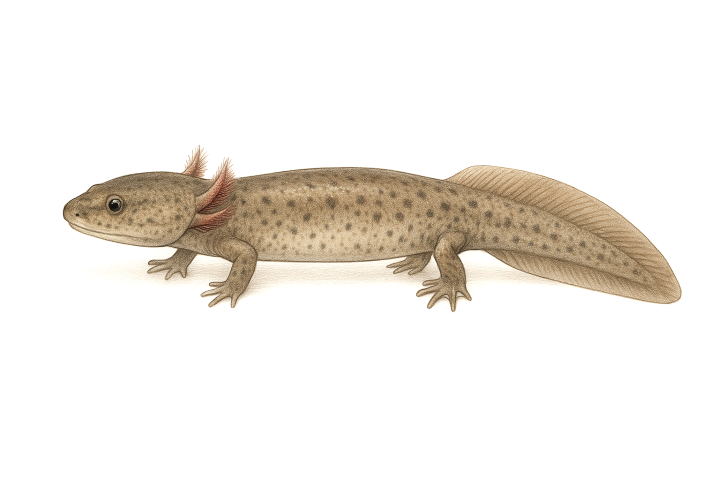
The Dwarf Waterdog is a fully aquatic salamander with a secretive lifestyle that keeps it mostly hidden under rocks and submerged logs. Although it’s not a common sight for most people, this species is fascinating because it’s one of only a few North American salamanders that lives its entire life underwater and keeps its external gills even as an adult. It’s smaller and less well-known than its cousin, the larger and more widespread Eastern Waterdog, but just as interesting once you get to know it.
Size & Physical Appearance
True to its name, the Dwarf Waterdog is on the smaller side. Adults usually range from about 4 to 6 inches long, though some may get a little bit larger. They have a smooth, gray or brownish-gray body with dark spots scattered across the back and sides. Their bellies are lighter, sometimes almost white.
One of the most distinctive features is their bushy external gills, which stick out from the sides of the head like little feather dusters. These gills are reddish and help them get oxygen from the water.
Males and females look very similar, though males tend to have slightly swollen cloacal regions during the breeding season. Juveniles resemble the adults but are obviously smaller and may have more noticeable spots.
Habitat and Range
Dwarf Waterdogs live in slow-moving streams, rivers, and sometimes ponds where the water is clean and well-oxygenated. They like to hide under rocks, leaf litter, or submerged logs during the day and are most active at night.
This species is found in the southeastern United States, mainly in the Coastal Plain regions of South Carolina, Georgia, and parts of North Carolina and Florida. They tend to stay at low elevations, rarely venturing into mountainous areas.
Diet
These little salamanders are carnivorous and not too picky. In the wild, they feed on a variety of aquatic invertebrates such as:
- small insects
- crustaceans
- worms
- mollusks
They hunt at night, often slowly probing through the leaf litter on the bottom of streams to find prey. Their sit-and-wait hunting strategy helps them stay unnoticed by predators.
Lifespan
In the wild, Dwarf Waterdogs can live for up to 10 years, though many don’t make it that long due to predation or habitat changes. In captivity, their lifespan might be slightly longer if conditions are stable and clean, but this species isn’t commonly kept as a pet.
Identification Tips
Telling Dwarf Waterdogs apart from other aquatic salamanders might take a bit of practice, but here’s what to look for:
- Size: They’re smaller than the closely related Eastern Waterdog, which can grow up to 13 inches.
- Color and markings: Dwarf Waterdogs usually have a lighter body with more distinct spotting.
- External gills: Like all members of the genus Necturus, they keep their external gills for life. Hellbenders and other large aquatic salamanders do not keep them as adults.
- No lungs: This species relies entirely on gill and skin respiration, unlike some semi-aquatic salamanders that have lungs or can breathe air more easily.
If you’re in the Southeast and find a small, spotted salamander swimming in a clear stream with obvious red gills, you’re likely looking at a Dwarf Waterdog.
Fun Fact
Unlike many amphibians that go through dramatic metamorphosis, the Dwarf Waterdog is neotenic — meaning it stays in its larval form for life. It never develops lungs or eyelids, and those feathery gills stick around permanently. It’s one of nature’s great examples of staying true to your roots — or in this case, your gills!
Whether you’re a student doing a project or a nature enthusiast looking to learn more about freshwater wildlife, the Dwarf Waterdog is a great example of the hidden diversity of the southeastern U.S. Keep an eye out next time you’re near a stream — though you may have better luck flipping a few submerged rocks and quietly observing. Just remember: always put rocks back where you found them!