
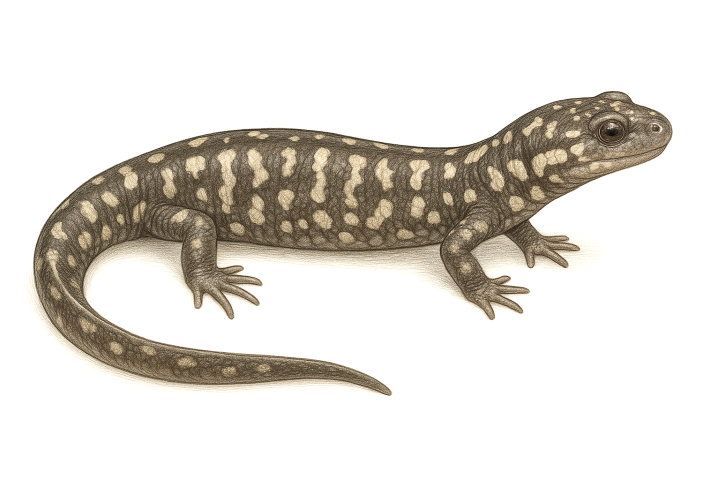
The Frosted Flatwoods Salamander is a rare and secretive amphibian with a silvery, frosted pattern that gives it a delicate, almost magical look. Found only in a handful of places in the southeastern U.S., this elusive salamander lives most of its life underground and appears mainly during the breeding season. It’s not a species you’re likely to stumble upon unless you’re in the right spot at the right time — which makes it all the more intriguing.
Size & Physical Appearance
Adult Frosted Flatwoods Salamanders are medium-sized for a mole salamander. They typically measure between 3.5 to 5.5 inches from snout to tail tip.
Their most striking feature is their coloration: a dark gray to black body covered in a silvery white, frosted pattern that looks like swirling lichen or frost on a windowpane. These markings are more than just pretty — they help them blend into the leaf litter of their pine forest habitat.
Young salamanders may have more distinct markings, while adults become darker and sometimes lose the contrast. Males and females look quite similar, though females are usually a bit more robust.
Habitat and Range
The Frosted Flatwoods Salamander prefers habitats that are becoming increasingly rare: longleaf pine flatwoods and savannas that are wet in winter but dry in summer. They rely on shallow, temporary ponds for breeding, and then spend the rest of the year hiding beneath the leaf litter, logs, or underground burrows.
Their remaining range is limited to parts of Florida, Georgia, and southeastern South Carolina, mostly in the coastal plain region. Elevation is generally low — these are flat, wetland-dependent habitats that need periodic fire to stay healthy.
Because of habitat loss, their distribution today is highly fragmented, and the species is listed as federally threatened.
Diet
Like many salamanders, they’re carnivorous. In the wild, Frosted Flatwoods Salamanders feed on small invertebrates like insects, spiders, worms, and snails. They hunt at night, typically under the cover of darkness and damp conditions, using their sticky tongues to snag unsuspecting prey.
Larvae are aquatic and will eat tiny aquatic invertebrates and insects, including mosquito larvae and small crustaceans.
Lifespan
In the wild, their exact lifespan is not well documented, but generally, mole salamanders like this one can live 5 to 10 years. In captivity, they may live a bit longer with proper care, but they’re almost never kept as pets due to their rarity and conservation status.
Identification Tips
Here’s how to tell a Frosted Flatwoods Salamander from other similar-looking species:
- Pattern: That frosted or reticulated silver pattern is unique. It’s unlike the bold yellow spots of a Spotted Salamander or the solid gray of the Marbled Salamander (which has more chunky white or gray bands).
- Size and shape: Slender body and tail, with a narrow head and relatively long legs for a mole salamander.
- Timing: They breed in late fall to early winter — unusual timing that can help distinguish them from other salamanders nearby.
If you’re in the Southeast and see a small black salamander with icy-white markings near a pine flatwood pond in the fall, you might just be looking at this rare amphibian.
Fun Fact
This salamander is so tied to its habitat that it won’t breed without the right shallow wetlands — and those ponds only form in certain years when rainfall is just right. That means entire generations can be skipped if conditions are off. It’s one of the reasons conservation efforts for this species are so tricky — and so important.
Wrap-Up
The Frosted Flatwoods Salamander is a beautiful but disappearing piece of the southeastern landscape. If you’re lucky enough to spot one, you’re witnessing a species that very few people have seen in the wild. Protecting its habitat helps not just this salamander but a whole community of fire-dependent, wetland-loving plants and animals.
If you’re exploring pine flatwoods in the fall, keep your eyes open — and tread carefully.