
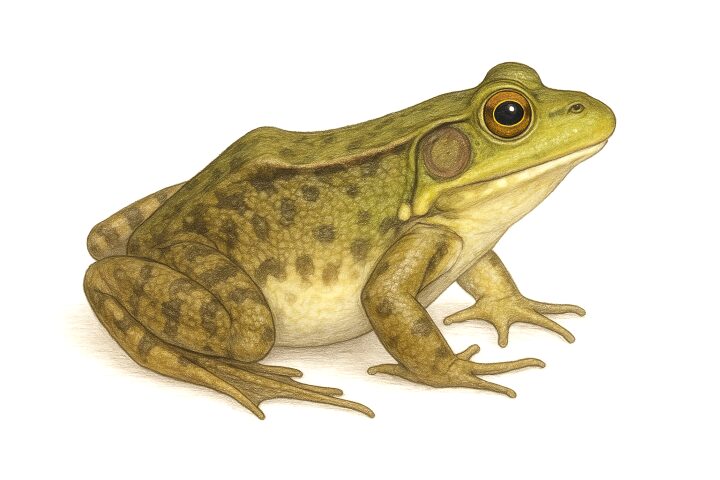
If you’ve ever walked near a pond or slow-moving stream in the eastern U.S. and heard a sound like a loose banjo string being plucked, you might have already met the Green Frog. These amphibians are common, but that doesn’t make them any less interesting. With their bright green faces and loud twangy calls, they’re often the first frog kids and adults alike learn to recognize.
They belong to the same genus as the American Bullfrog, but Green Frogs are smaller and have their own charm. Whether you’re hiking, fishing, or just poking around a backyard pond, this is a frog you’re likely to see.
Size & Physical Appearance
Green Frogs are medium-sized frogs. Adults usually measure between 2.5 to 4 inches long, although the occasional big one may push past 4.5 inches. Their most noticeable feature is — no surprise — their green coloring around the face and upper lips. Some are more olive than green, and others have a bit of brown or bronze mixed in.
Their backs are generally spotted or blotchy in appearance, usually with shades of brown or green. The belly is whitish or pale yellow and sometimes mottled. Males may have yellow throats, especially during breeding season, while females’ throats tend to stay pale.
Young frogs (juveniles) look like smaller versions of adults but are often more vibrantly green and lack some of the adult coloration.
One key feature? Green Frogs have a sharp ridge of skin (called a dorsolateral fold) running from behind each eye down the sides of the back. That ridge is a major clue for telling them apart from similar frogs.
Habitat and Range
Green Frogs are right at home in just about any freshwater habitat. You’ll find them around lakes, ponds, marshes, slow-flowing streams, ditches, and even backyard fish ponds. As long as there’s some water nearby and a mix of sunny and shady spots, they’re likely to move in.
They prefer eastern and central North America. Their range stretches from the southeastern Canadian provinces down through New England, the Midwest, and into the southern U.S. states including parts of Florida, Texas, and the Carolinas. They can even be found in Appalachian regions and foothills — often up to about 4,000 feet in elevation.
Diet
Green Frogs are opportunistic feeders, which means they’ll eat just about anything they can fit in their mouths. Their menu includes:
- Insects (like beetles, flies, and crickets)
- Worms and snails
- Spiders
- Small fish
- Other frogs and tadpoles (yes, even their own species)
Tadpoles mostly graze on algae until they metamorphose into froglets.
Lifespan
In the wild, Green Frogs can live about 5 to 10 years, though many don’t make it quite that long due to predators and environmental changes. In captivity, with proper care, they’ve been known to live slightly longer.
Identification Tips
Telling a Green Frog apart from other similar species like the Bullfrog or Bronze Frog is simple once you know what to look for.
Here are the key features to focus on:
- Dorsolateral folds: Green Frogs have that skin ridge running from behind the eye down the side of the back. Bullfrogs do not — their skin is smooth there.
- Size: Green Frogs are smaller than Bullfrogs, which can grow over 6 inches long.
- Call: Green Frogs make a distinctive “plunk” sound, like a loose banjo string. Bullfrogs have a deep, rumbling jug-o-rum call in comparison.
- Throat color: In breeding season, male Green Frogs often have a brighter yellow throat — a subtle clue, but helpful.
So if you spot a frog with green around the mouth, visible skin ridges on the back, and a medium size, chances are, it’s a Green Frog.
Fun Fact
Green Frogs can change their call pitch to match their surroundings if there’s too much background noise — a kind of natural volume control! Scientists have even studied how Green Frogs adjust their vocal tones when competing with Bullfrogs. Pretty impressive for a pond-dweller.
Wrapping It Up
The Green Frog is one of those species that’s easy to overlook because it’s so common — but it rewards a second glance. From its banjo-like call to its vibrant green face, it’s a familiar (but still fascinating) amphibian found in backyards and wild wetlands alike.
If you’re just getting into amphibian watching, the Green Frog is a great one to start with. It’s easy to find, fun to listen to, and surprisingly adaptable. Keep your eyes (and ears) open next time you’re near water — you might meet one of these green-faced jumpers nearby.
Happy frog-spotting!