
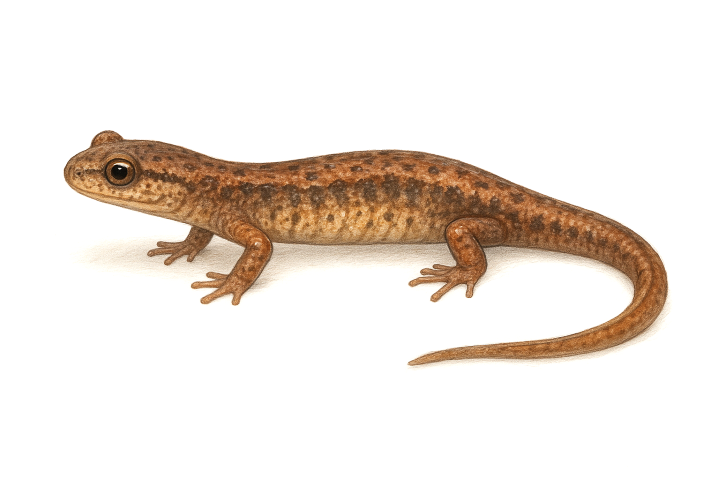
At just a few inches long, the Pygmy Salamander might be easy to miss, but it’s a fascinating little amphibian with some big adaptations. Unlike many of its close relatives, it doesn’t rely on streams — it lives entirely on land. What really makes this species stand out is where it lives: high in the cool, misty mountains of the southern Appalachians. It’s one of the few salamanders that spends its life away from water, even when laying eggs.
Size & Physical Appearance
Pygmy Salamanders are among the smallest of their kind in the U.S., measuring only 1.5 to 2.5 inches (about 4 to 6.5 cm) from snout to tail.
Their coloring is generally reddish-brown or coppery, often with a faint darker stripe running down the back and fine speckling along the sides. They can sometimes have a faint “herringbone” pattern down the back, especially in younger individuals.
The belly tends to be a lighter color, usually speckled with white, gray, or bronze. Males and females look quite similar, although males have a broader head and slightly more robust limbs during the breeding season.
Habitat and Range
This salamander is a mountain dweller and a bit of a homebody. Pygmy Salamanders are found only in the southern Appalachian Mountains</strong, specifically in high-elevation forests of North Carolina and eastern Tennessee, with a few confirmed spots in northern Georgia and southwestern Virginia.
They stick to cool, moist hardwood forests, usually above 4,500 feet in elevation. These forests are filled with moss, leaf litter, and decaying logs — perfect salamander habitat. Unlike many members of the Desmognathus genus (which are often stream-dependent), the Pygmy Salamander is completely terrestrial and avoids water.
Diet
Pygmy Salamanders feed on tiny invertebrates, including:
- Springtails
- Tiny beetles
- Mites
- Small fly larvae
Since they live in cooler environments where prey is less abundant, they’re opportunistic feeders, grabbing whatever fits in their mouth and moves slowly enough to catch.
Lifespan
In the wild, Pygmy Salamanders are thought to live around 8 to 10 years, which is pretty impressive for such a small creature.
Captive lifespan isn’t well-documented — partly because they’re rarely kept outside of specialized research or conservation settings. They require very specific environmental conditions that are hard to replicate.
Identification Tips
The Pygmy Salamander can be confused with juvenile Dusky Salamanders (also in the Desmognathus genus), but there are a few key differences:
- No aquatic stage: Unlike some of their lookalikes, Pygmy Salamanders develop entirely on land. No gills, no aquatic larvae.
- Shorter, stubbier body: Adults are fully grown at just a few inches, with short legs and a blunt snout.
- No visible tail keel: Many stream-dwelling salamanders have a ridge or keel on the tail to help with swimming. Pygmies don’t need that because they stay away from water.
- Habitat is a clue: If you’re above 4,500 feet on a cool mountain ridge and find a tiny salamander under moss or a log, there’s a good chance it’s a Pygmy.
Still not sure? Only a few salamanders live in those specific high-elevation forests year-round. That alone helps narrow it down.
Fun Fact
Unlike many amphibians, the Pygmy Salamander skips the tadpole stage entirely. Young hatch out of eggs laid in moist moss or under bark as fully formed, miniature adults — no swimming necessary. It’s one of the few completely terrestrial salamanders in the U.S.
In Summary
The Pygmy Salamander might not be flashy, but it’s a great example of how amphibians adapt to specific environments. Living far from streams and spending its entire life in the cool, misty heights of the Appalachians, this salamander has carved out a quiet but fascinating niche. If you’re ever hiking in the Smokies or nearby highlands, keep an eye out under damp logs and moss. Just remember — these salamanders are sensitive to disturbance, so observe gently and leave them where you found them.
Anytime you spot one, it’s like discovering a little secret hidden in the forest floor.