
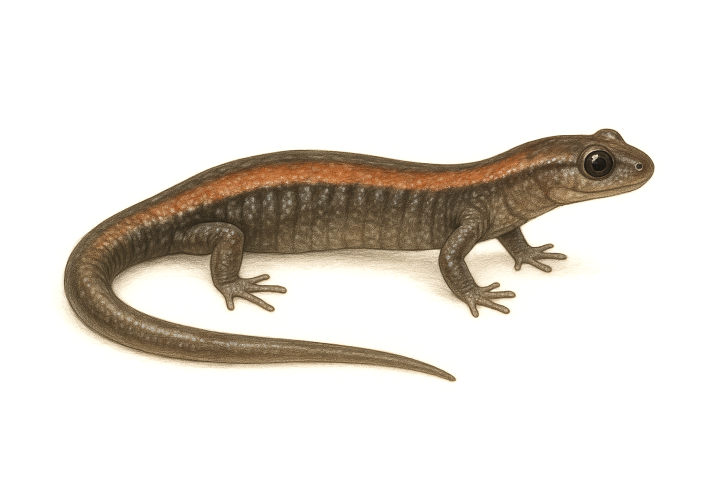
The Shenandoah Salamander is a small, rare amphibian with a very exclusive address: it only lives on the tops of a few mountains in Virginia’s Shenandoah National Park. What makes this species so fascinating is just how specialized and elusive it is. You won’t find it in ponds or streams like many other salamanders — it lives in dry, rocky forest slopes. And because of its tiny range, it’s considered endangered and ranks high on conservationists’ watchlists. If you spot one, consider yourself lucky!
Size & Physical Appearance
The Shenandoah Salamander is pretty small, typically ranging from about 2.5 to 4 inches long, including the tail. Its body is slender and smooth, with relatively long legs for a salamander.
What really makes it stand out are its color patterns. Most individuals have a dark brown or black body with a stripe down the back. The stripe can be red, orange, or yellow, depending on the individual. Some may lack the stripe altogether. Its belly is dark gray to black.
There aren’t major visual differences between males and females that are easy to spot in the field, and juveniles look a lot like the adults, just smaller and sometimes a bit duller in color.
Habitat and Range
This salamander is a mountaintop specialist. It only lives in three known areas — the tops of Hawksbill, Stony Man, and The Pinnacle mountains — all within Shenandoah National Park in Virginia. Elevation matters a lot here. You won’t find them below about 3,000 feet.
It prefers dry, rocky talus slopes in deciduous forests, often surrounded by mosses, leaf litter, and lichen-covered rocks. Because it’s a terrestrial species, it doesn’t live in water. Instead, it breathes through its skin and depends on high humidity from its cool, shaded mountain home.
Diet
The Shenandoah Salamander is a nocturnal hunter. It feeds on a variety of small invertebrates, including mites, ants, springtails, beetles, and other small arthropods. It uses a sticky tongue to snag its prey, kind of like a small insect vacuum.
Since it’s active at night and often hidden under rocks or logs during the day, most of this action happens when we’re not looking.
Lifespan
In the wild, these salamanders probably live around 8 to 10 years, though exact numbers are tough to pin down due to their elusive nature and protected range. In captivity (not common due to their rarity), they may live a little longer, but they’re not a species often kept outside research settings.
Identification Tips
Telling the Shenandoah Salamander apart from similar species takes a sharp eye. The most common mix-up is with the Red-backed Salamander (Plethodon cinereus), which shares part of its range and looks quite similar.
Here are a few tips:
- Tail Color: Shenandoah Salamanders usually have a dark or black tail underneath, while Red-backed Salamanders often have a lighter, mottled tail base.
- Stripe: Both species can have reddish stripes, but Shenandoah Salamanders sometimes lack a stripe altogether, while Red-backed almost always have one.
- Location: If you’re above 3,000 feet in one of those three mountain areas and see a salamander in a dry, rocky slope — it’s much more likely to be a Shenandoah.
Fun Fact
The Shenandoah Salamander doesn’t just have a tiny range — it’s also in competition with a close cousin. It shares its mountaintop habitat with the more widespread Red-backed Salamander, and the two compete for space underneath rocks and logs. Unlike its neighbor, the Shenandoah Salamander can’t tolerate wetter soil or cooler conditions, so it’s basically hanging on to these dry ridges while the Red-backed is slowly pushing in from below.
Scientists think that this competition is part of what makes the species so vulnerable, especially as climate change threatens to make its already limited habitat even smaller.
Quick Takeaway: The Shenandoah Salamander is a rare mountaintop amphibian found only in Virginia. Small but tough, it thrives in dry, rocky forest slopes and is a true specialist. Keep your eyes open if you’re hiking high in Shenandoah National Park — and tread lightly!