
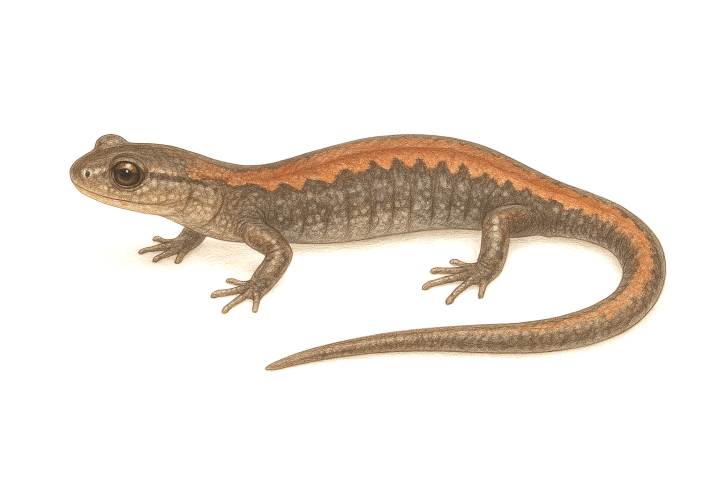
The Southern Zigzag Salamander is a small, secretive amphibian that’s easy to overlook but fascinating if you know where to look. True to its name, this little salamander often sports a bold zigzag or wavy stripe down its back. It’s a member of the Plethodon genus—commonly known as lungless salamanders—which means it breathes entirely through its skin and the lining of its mouth. These salamanders are masters of moisture and mystery, living quiet lives under rocks and logs in the shaded woodlands of the southern U.S.
Size & Physical Appearance
Southern Zigzag Salamanders are fairly small. Adults usually range from 2.5 to 4 inches in total length, including the tail.
Their most distinctive feature is the irregular stripe running down the back, which can be anything from bright orange-red to a dull rusty color. The base color is usually a dark brown or black, giving that stripe some real contrast. Some individuals lack the stripe entirely and are a uniform dark color—known as the “leadback” morph.
Belly color? Typically a mottled black-and-white or grayish appearance that sets them apart from other slender salamanders.
Males and females look pretty similar overall. However, during the breeding season, males may develop slightly swollen glands near the corners of the head, and their tails may taper a bit differently.
Habitat and Range
You’ll mostly find the Southern Zigzag Salamander in the southern Appalachian region. Its range includes parts of Tennessee, Kentucky, Alabama, and a few neighboring spots with suitable habitat.
They strongly prefer cool, moist environments like forested hillsides, ravines, and shaded slopes. You’re more likely to find them at low to mid elevations, typically under rocks, logs, or within leaf litter. They come out more frequently on damp or rainy days, especially in spring and fall.
Unlike frogs, they aren’t tied to water for breeding, so look for them well away from streams or ponds. That’s one of the perks of being a terrestrial-breeding plethodontid.
Diet
These salamanders are carnivorous and feed mostly on small invertebrates. Their diet includes:
- Tiny insects
- Spiders
- Springtails
- Mites
- Small worms and snails
They hunt mostly at night or during cool, damp weather when their prey is active. Thanks to their small size, they can pick around leaf litter and crevices to find food others might miss.
Lifespan
In the wild, Southern Zigzag Salamanders can live around 8 to 10 years. In captivity, with consistent care and the right moisture levels, they may live slightly longer—though these salamanders aren’t commonly kept as pets due to their specific habitat needs.
Identification Tips
At first glance, the Southern Zigzag Salamander might resemble the Eastern Red-backed Salamander (Plethodon cinereus), but there are a few key differences:
- Stripe pattern: Southern Zigzag Salamanders often have a jagged or irregular zigzag stripe. The Red-backed Salamander typically has a smoother, straight-edged stripe.
- Location: Check the range. If you’re farther south in the Appalachians, you’re more likely to see P. ventralis.
- Belly color: Southern Zigzag Salamanders tend to have a heavily mottled black-and-white belly, while red-backed salamanders have a plainer, lighter underside.
Close inspection might be needed—but take care not to handle them too much, since they absorb moisture and oxygen through their skin. Clean hands or just a camera lens is better than picking them up.
Fun Fact
Southern Zigzag Salamanders don’t have lungs. Instead, they breathe entirely through their skin and the lining of their mouth. This unique adaptation means they absolutely depend on staying moist—dry conditions can quickly become fatal for them. So, every time you see one, you’re looking at an amphibian that is literally breathing through its skin as it crawls through the leaf litter.
You wouldn’t guess it from their tiny size, but that moisture-breathing lifestyle makes them very sensitive to environmental changes—so they’re often used as indicators of forest health.
Looking to spot one in the wild? Try flipping flat rocks or logs in wooded areas after rain—but always put them back carefully. These salamanders are part of a quiet ecosystem that relies on everything staying just as damp, dark, and undisturbed as nature intended.