
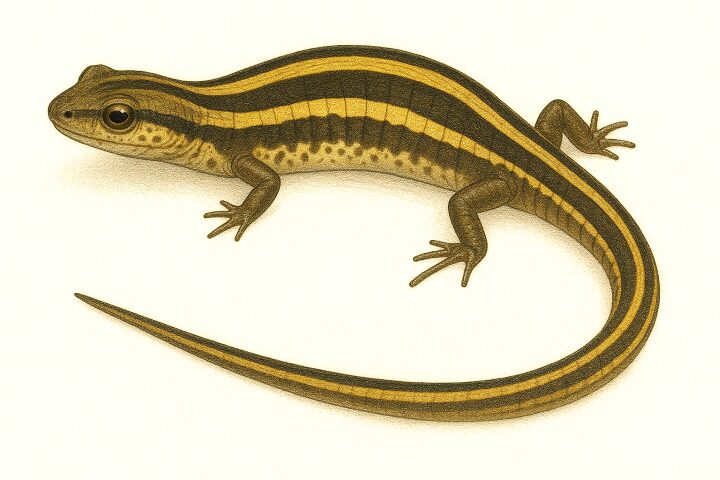
If you’re exploring the forests and creek beds of the southeastern U.S., you might spot a slender little salamander with bold black racing stripes. That’s the Three-lined Salamander — a striking amphibian that’s easy to admire and fun to watch. These salamanders tend to be shy, but if you look closely near streams or under logs, you might be lucky enough to find one. Their sleek shape and bold markings make them one of the more eye-catching members of the lungless salamander family.
Size & Physical Appearance
Three-lined Salamanders are on the longer side for small woodland salamanders. Adults typically grow between 4 to 6 inches long, with some individuals reaching up to 7 inches.
Their bodies are slender and elongated, with a light yellowish or orange-tan background color. What really stands out are the three bold black stripes that run from the head down the back and tail — one along the center of the back and one on each side. These stripes make them easy to recognize, especially when compared to more mottled or spotted salamander species.
The belly is particularly interesting — it has a striking black-and-white marbled or reticulated pattern that looks almost like lace. Juveniles resemble adults in color pattern and size, just a bit smaller. Males and females look alike, though males tend to have slightly longer tails relative to body size.
Habitat and Range
Three-lined Salamanders are most at home in moist, forested areas near bodies of water. They prefer cool, shaded habitats like stream banks, seeps, and the edges of swamps. You can often find them under leaf litter, rocks, and fallen logs — especially in areas with clean water flow.
This species is native to the Southeastern United States. Its range includes:
- Virginia
- North Carolina
- South Carolina
- Georgia
- Alabama
- Mississippi
- Louisiana
- Parts of Florida
- Eastern Tennessee and Kentucky
They’re generally found at elevations from sea level up to about 2,000 feet, though they may occur a bit higher in mountain streams.
Diet
Like many lungless salamanders, Three-lined Salamanders are predators of small invertebrates. Their diet in the wild includes:
- insects
- spiders
- tiny worms
- crustaceans like small amphipods or isopods
They hunt mostly at night and use their keen sense of smell to track down prey. Their feeding strategy is sit-and-wait or slow stalking, quickly flicking out their sticky tongue to grab food.
Lifespan
In the wild, Three-lined Salamanders typically live around 5 to 10 years. Lifespan in captivity can be a bit longer if they’re cared for properly, but they’re not commonly kept as pets, so captive data is limited.
Identification Tips
If you’re trying to ID a salamander in the Southeast, the Three-lined Salamander has a few features that help it stand out:
- Three clear black stripes on an orange or tan background
- Marbled black-and-white belly (flip gently with care if you’re checking)
- Slender body with a very long tail, often more than half its total length
You might confuse this species with the Southern Two-lined Salamander (Eurycea cirrigera), which looks similar but has only two stripes and a much plainer belly. The Two-lined also tends to be smaller and more yellow.
Another look-alike is the Long-tailed Salamander (Eurycea longicauda), but that one usually has spots or broken bars down the back instead of unbroken lines, and the tail is often visibly spotted.
Fun Fact
Even though they live near water, Three-lined Salamanders don’t have lungs. Instead, like all members of the Plethodontidae family, they breathe entirely through their skin and the lining of their mouth — which is why clean, moist habitats are critical for their survival. Keeping their skin damp is literally a matter of life and breath!
Wrapping Up
The Three-lined Salamander is a great example of how dramatic and diverse amphibians can be — even in quiet forest corners most of us walk right past. If you’re into creek-hopping or forest hikes in the South, keep an eye out. These sleek little salamanders are part of what makes the region’s biodiversity so rich and worth protecting.
Want to help these amphibians? Avoid disrupting stream banks when exploring, and always turn logs and rocks gently — and put them right back how you found them. Little things like that make a big difference for species like this one.